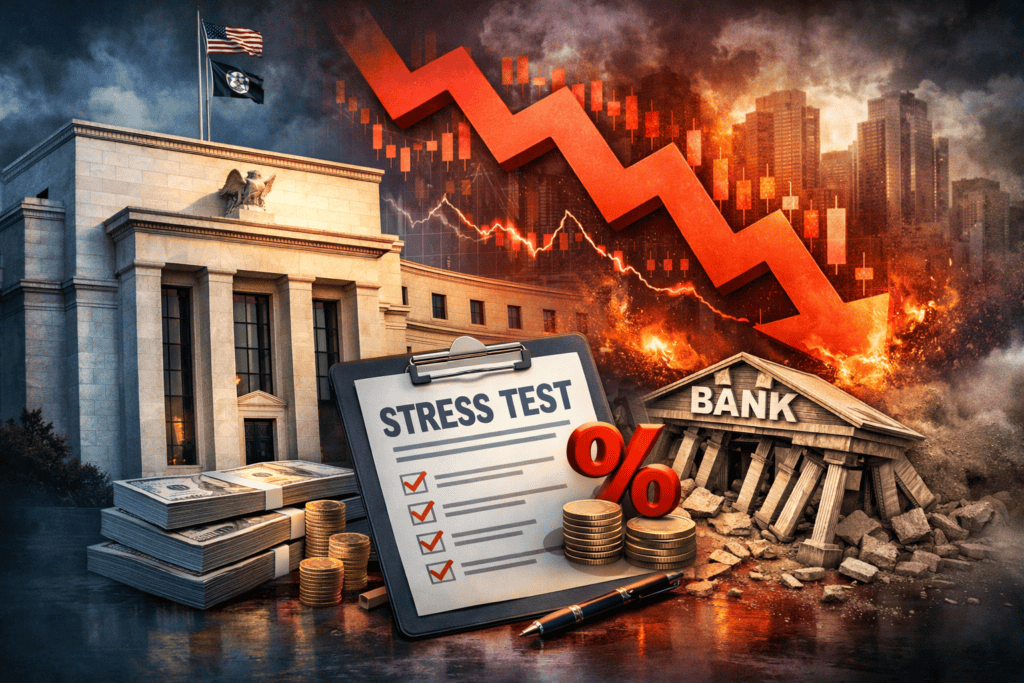
The Federal Reserve Board on Wednesday finalized the hypothetical scenarios for its annual bank stress test—an exercise designed to ensure that the nation’s largest banks can continue lending to households and businesses even during a severe economic downturn.
What the Fed Decided
- Scenarios finalized: The final scenarios closely mirror those proposed in October.
- Capital buffers unchanged: The Board voted to maintain current stress capital buffer (SCB) requirements through 2027.
- Why the pause: New SCB requirements will be calculated after incorporating public feedback into supervisory models.
“Waiting to calculate new stress capital buffer requirements until we receive public feedback will give us the opportunity to correct any deficiencies in our supervisory models,” said Michelle W. Bowman. She added that the approach should improve transparency, effectiveness, fairness, and public accountability.
How the Stress Test Works
The Fed’s annual stress test evaluates large banks’ resilience by estimating losses, net revenue, and capital levels under hypothetical recession scenarios extending two years into the future. Importantly, these scenarios are not forecasts and should not be read as predictions.
The 2026 “Severely Adverse” Scenario
For the 2026 cycle, 32 banks will be tested against a severe global recession featuring:
- Unemployment: Rising nearly 5.5 percentage points to a 10% peak.
- Market stress: Sharp volatility and widening corporate bond spreads.
- Asset price collapses:
- ~30% decline in house prices
- ~39% decline in commercial real estate prices
- Corporate debt pressure: Heightened stress across corporate credit markets.
Extra Tests for Trading-Heavy Banks
Banks with significant trading or custodial operations must also model:
- Counterparty default risk: Losses from the unexpected default of the largest counterparty during an acute market shock.
- Global market shock: Stress to trading and related positions.
Methodology Notes
A brief methodology document indicates the Fed intends to generally use the same models as the 2025 stress test, with limited adjustments, while awaiting public input before recalculating capital buffers in 2027.
Why It Matters
By locking in scenarios now and deferring new capital calculations until public feedback is incorporated, the Fed aims to strengthen confidence in the stress-testing framework—balancing rigor with transparency—while ensuring large banks remain capable of supporting the economy in extreme conditions.