Gold and silver prices could see heightened volatility — and potentially historic gains — as central bank buying, shifting portfolio strategies, and political uncertainty reshape global markets. That’s the outlook shared by Phil Streible in a recent market discussion analyzing precious metals, commodities, and macroeconomic risks.
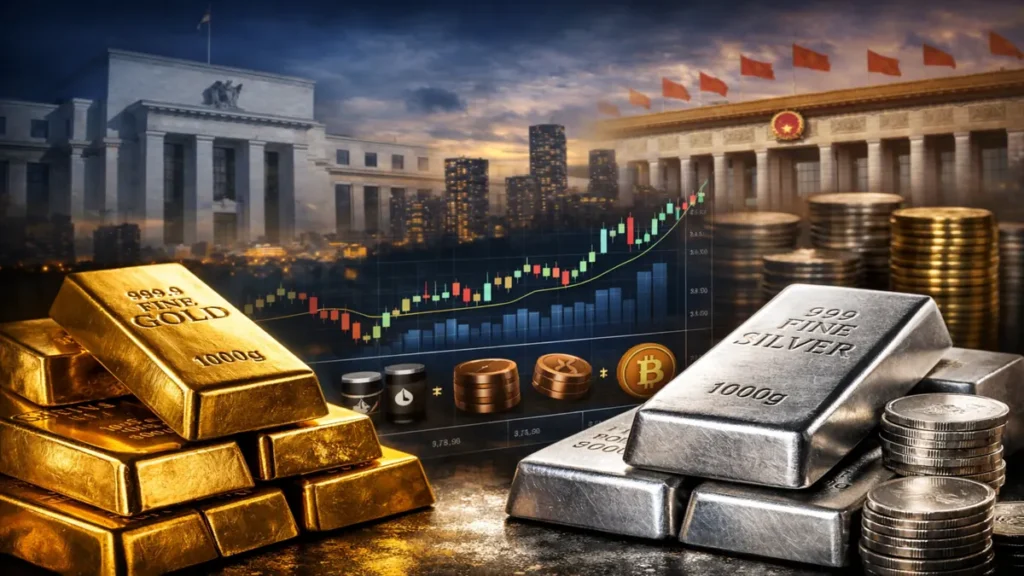
The conversation highlights why investors are increasingly rethinking traditional asset allocations — and why gold, silver, and other commodities are moving back to the center of portfolio strategy.
Gold Price Forecast: Why $6,000 Is in Play
Streible projects that gold could climb as high as $6,000 by 2026, driven by a powerful mix of macro forces. Central banks continue to accumulate gold at a record pace, while private investors are adding exposure through ETFs. At the same time, expectations are building for eventual monetary easing by the Federal Reserve.
Gold’s inverse relationship with the U.S. dollar remains critical. Any sustained weakening in the dollar index — especially amid falling bond yields — historically supports higher gold prices. Additional pressure on U.S. debt demand, including reports of Chinese regulators encouraging banks to reduce exposure to U.S. Treasuries, could further amplify the move.
The 60/40 Portfolio Is Fading — Commodities Step In
According to Streible, the traditional 60% stocks / 40% bonds portfolio structure no longer offers the diversification it once did. Investors are increasingly looking to commodities as an alternative hedge against inflation, geopolitical risk, and currency volatility.
Gold, silver, copper, crude oil — and even Bitcoin — are being considered as strategic, small-percentage allocations. Streible suggests starting with 1%–2% of net worth in gold, with a long-term ceiling closer to 10% for those seeking broader diversification.
Central Banks Are Rewriting the Gold Playbook
One of the strongest bullish signals for gold comes from central banks themselves. Global monetary authorities are diversifying away from the U.S. dollar and increasing their gold reserves.
China, for example, is reportedly targeting a jump in gold holdings from roughly 8% to as much as 30% of reserves over time. This trend reflects gold’s status as a Tier 1 asset under Basel III reforms, reinforcing its role as a core reserve asset rather than a speculative trade.
Gold Miners vs. Physical Gold: A Word of Caution
While gold mining stocks can offer leverage to rising prices, Streible urges caution. Miners often face operational risks — including high debt levels, rising fuel costs, labor issues, and interest-rate sensitivity — that can dilute gains even in strong gold markets.
Instead, he favors direct exposure through gold futures or ETFs that closely track the metal’s price, offering cleaner participation without company-specific risks.
Silver Outlook: Volatility, Deficits, and Industrial Demand
Silver remains one of the most volatile precious metals, but its long-term fundamentals remain compelling. A multi-year supply deficit, combined with booming industrial demand from AI infrastructure, electric vehicles, and solar energy, could drive prices sharply higher.
Streible notes that silver could potentially move back into the “$90s” range over time. However, sustained high prices carry risks — particularly substitution, where manufacturers switch to cheaper materials, eventually reducing demand.
Economic Data Could Shift the Metals Market Fast
Upcoming U.S. economic data — including jobs and inflation reports — could act as a near-term catalyst. Weaker-than-expected employment data may push bond yields lower, strengthen gold, and further pressure the dollar.
Precious metals tend to perform best when markets anticipate slower growth paired with easier monetary policy — a scenario investors are increasingly pricing in.
Political Signals: Trump’s Fed Pick in Focus
The discussion also touches on former President Donald Trump’s reported interest in Kevin Warsh as a potential Federal Reserve pick. A shift in leadership — and in economic modeling — could signal a more aggressive approach to rate cuts, which would likely be supportive for gold and silver prices.
Bottom Line
Gold and silver are no longer niche hedges — they are increasingly central to global investment strategy. With central banks buying, portfolio models evolving, and political uncertainty rising, precious metals could be entering a structurally stronger phase that extends well beyond short-term price swings.
The security on this platform makes me feel much more comfortable with my deposits. Quick access and no lag at ciputra88login.
Super impressed with the game variety here. Everything loads quickly and I haven’t had any lag issues. Check out vnnk8812 if you want a great gaming experience.
Solid platform with some of the best odds I’ve seen. I feel like I have a much better chance of winning here. Big thanks to kr55bet.
[8596]KHWN855 – Casino Uy Tín: Đăng Nhập, Tải App & Nhận Khuyến Mãi Mới Nhất,KHWN855 là cổng game casino uy tín hàng đầu Việt Nam. Truy cập ngay để đăng nhập, tải app nhanh chóng và săn các chương trình khuyến mãi mới nhất. Trải nghiệm cá cược an toàn, minh bạch với tỷ lệ thưởng hấp dẫn tại KHWN855. visit: khwn855