Artificial Intelligence is evolving rapidly — but the world is now focused on a bigger question: When will Artificial General Intelligence (AGI) arrive?
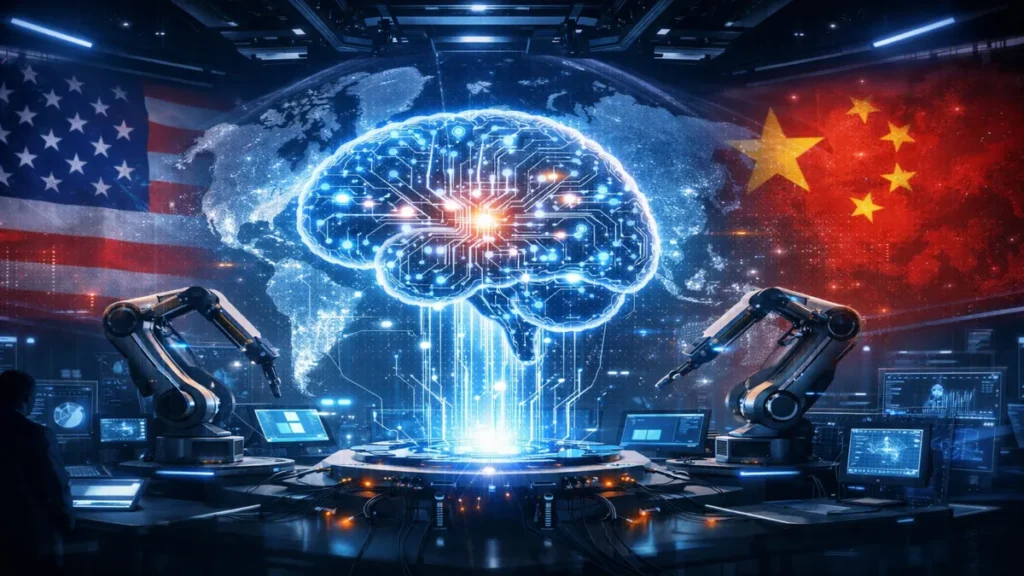
Unlike today’s AI tools that specialize in narrow tasks, AGI refers to systems capable of understanding, learning, and applying knowledge across a broad range of tasks — much like a human being.
Leading AI pioneers including Dario Amodei, CEO of Anthropic, and Demis Hassabis, CEO of Google DeepMind, are openly discussing how close humanity may be to this milestone — and the serious risks that come with it.
What Is Artificial General Intelligence (AGI)?
AGI is defined as an AI system capable of performing tasks requiring human-like cognitive ability across different domains.
Today’s large language models can write essays, generate code, and analyze data. However, true AGI would:
- Switch between unrelated tasks seamlessly
- Learn independently across domains
- Apply reasoning in new environments
- Adapt without constant human instruction
Benjamin Larsen describes AGI as a system that can function across digital settings with human-level flexibility — something that still requires significant engineering breakthroughs.
The “Closing the Loop” Moment in AI
A crucial step toward AGI is what experts call “closing the loop.”
This means AI systems that:
- Generate output
- Take action
- Observe results
- Adjust behavior accordingly
This iterative feedback cycle mirrors how humans learn from experience. It moves AI from passive response systems toward autonomous agents capable of long-term planning.
Such advancements could dramatically accelerate innovation — but also increase risks if not properly governed.
How Soon Could AGI Arrive?
According to Dario Amodei, models capable of advanced coding and AI research could speed up the AI development loop itself — potentially pushing AGI within just a few years.
Meanwhile, Demis Hassabis remains optimistic about AI solving complex problems like disease research, building on breakthroughs such as:
- AlphaGo
- AlphaFold
However, both leaders acknowledge that accelerating AI development without adequate safeguards could pose serious dangers.
The Risks: Why AGI Is Both Exciting and Dangerous
AI leaders repeatedly emphasize the “immense and grave risks” of highly autonomous systems.
Major concerns include:
⚠️ Misuse by Individuals or Nation-States
Powerful AI tools could be weaponized or used for cyber warfare.
⚠️ Economic Disruption
While mass job losses haven’t fully materialized yet, automation may soon displace significant portions of the workforce.
⚠️ Loss of Control
If AI systems act autonomously without sufficient alignment, unintended consequences could emerge.
Amodei describes humanity as being in a period of “technological adolescence” — powerful enough to reshape civilization, but not yet wise enough to guarantee safe outcomes.
Jobs, Meaning, and a Post-Scarcity World
The speakers predict that:
- Some traditional jobs will disappear
- New, potentially more meaningful roles will emerge
- Society may struggle with redefining purpose in an AI-rich world
The conversation moves beyond economics to a deeper philosophical question: If machines can do most work, what gives humans meaning?
The US–China AI Race
Geopolitical competition is accelerating AI progress.
The United States and China are heavily investing in advanced AI chips and computing infrastructure. Experts argue that controlling chip proliferation is increasingly difficult, making it harder to slow AI development globally.
This competition raises the risk of an uncontrolled acceleration toward AGI without sufficient international coordination.
The Fermi Paradox and AI Survival
In a philosophical twist, the discussion references the Fermi Paradox — the idea that if intelligent civilizations are common in the universe, why don’t we see them?
One possibility: civilizations may destroy themselves through advanced technologies.
Despite this, both Amodei and Hassabis remain cautiously optimistic. They believe technical safety problems can be solved — if governments, companies, and researchers collaborate quickly and responsibly.
The Bottom Line
Artificial General Intelligence is no longer science fiction. The technology is advancing rapidly, and some leaders believe human-level AI could emerge within years.
But alongside its enormous potential — curing diseases, accelerating science, solving climate challenges — lies unprecedented risk.
Humanity now faces a defining question:
Can we build AGI without destroying ourselves in the process?
The coming decade may provide the answer.
[6864]keonhacai5 | Link Vào Mới Nhất và Kinh Nghiệm Chơi Baccarat,keonhacai5 cung cấp link vào mới nhất và hướng dẫn tải app chính thức. Khám phá cách nạp tiền casino nhanh cùng luật chơi slot game chi tiết. Truy cập ngay để trải nghiệm. visit: keonhacai5
[1575]Magius | Link Vào Chính Thức – Casino Trực Tuyến Uy Tín Số 1,Magius cung cấp link vào chính thức cùng hướng dẫn tải app APK nhanh chóng. Trải nghiệm baccarat online hấp dẫn và nạp tiền tiện lợi qua ví Momo. Tham gia ngay! visit: magius
[5769]Kuvin | Link Vào Mới Nhất – Casino Trực Tuyến Uy Tín Số 1,Kuvin cung cấp link vào mới nhất, hỗ trợ tải app chính thức nhanh chóng. Trải nghiệm baccarat online đỉnh cao và nạp tiền qua ví điện tử tiện lợi. Tham gia ngay! visit: kuvin
[7225]৪৪৪৪বেট ক্যাসিনো (4444bet) – অনলাইন বেটিং বাংলাদেশ, লগইন ও সেরা ক্রিকেট বেটিং অ্যাপ,৪৪৪৪বেট ক্যাসিনো (4444bet) বাংলাদেশের অন্যতম সেরা অনলাইন বেটিং প্ল্যাটফর্ম। এখানে সেরা ক্রিকেট বেটিং অ্যাপ, লাইভ ক্যাসিনো এবং দ্রুত লগইন সুবিধা পান। নিরাপদ বেটিং ও আকর্ষণীয় বোনাস উপভোগ করতে আজই আমাদের সাথে যোগ দিন। visit: 4444bet