A growing number of Americans are actively pursuing dual citizenship — and for many, it’s no longer just about honoring family heritage.
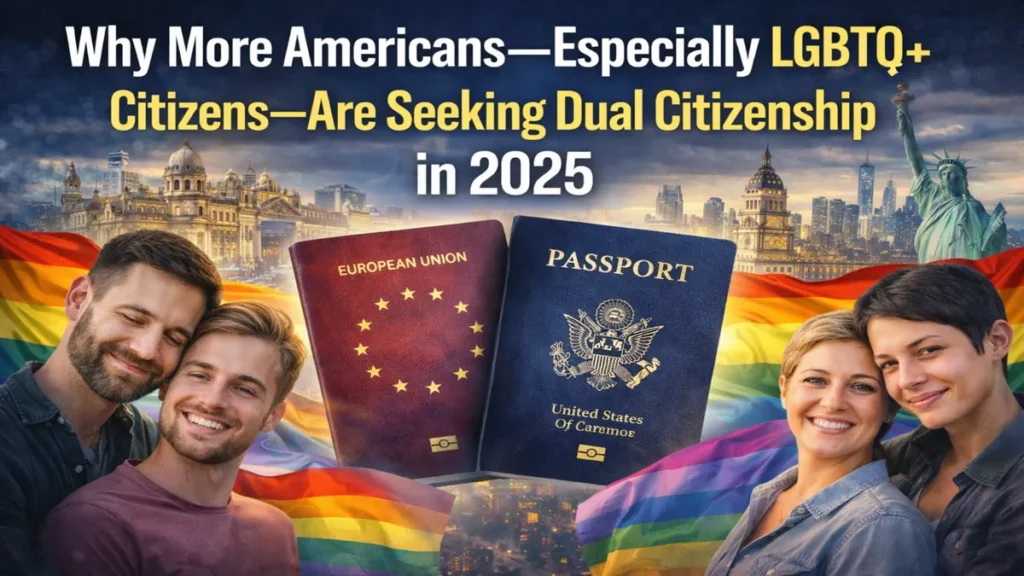
According to insights shared by Daniel Atz, CEO of Citizenship.eu , inquiries from U.S. citizens have surged in recent years, particularly among members of the LGBTQ+ community.
What was once a niche legal process has evolved into a broader strategy for mobility, security, and long-term flexibility.
LGBTQ+ Americans Driving a Major Surge
Since 2021, LGBTQ+-related inquiries about dual citizenship have risen by approximately 30%.
The momentum accelerated through 2023 and 2024 as motivations shifted. Previously, many Americans pursued second passports to reconnect with ancestral roots. Now, more individuals are focused on:
- Personal security
- Political stability
- Economic optionality
- Lifestyle flexibility
For some, dual citizenship represents a safeguard — a way to keep options open in an uncertain political and socioeconomic climate.
Millions of Americans May Qualify Through Ancestry
An estimated 20 to 45 million Americans may be eligible for citizenship through family lineage in Europe and other countries.
Ancestry-based programs are often:
- More affordable than investment visas
- Permanent rather than temporary
- Less dependent on income or asset thresholds
Approval rates vary widely by country:
- Luxembourg and Croatia report high eligibility rates (up to 90% for qualified applicants)
- France and some others have very low approval rates (under 2%)
Eligibility depends heavily on documentation, generational limits, and changing nationality laws.
Why Timing Matters: Europe Is Tightening Rules
Between 2010 and 2020, many European countries expanded citizenship-by-descent policies. However, recent years have brought stricter criteria and policy reversals in some nations.
Experts suggest that Americans who believe they may qualify should evaluate their options sooner rather than later, as some programs may close or narrow eligibility requirements.
The Power of an EU Passport
For many Americans, the most attractive benefit of dual citizenship is European Union mobility.
An EU passport allows:
- The right to live and work in 27 EU countries
- Freedom of movement across the Schengen Area
- The flexibility to relocate within Europe based on personal preferences
Even if one ancestral country has limited social protections, EU citizenship allows residency in another member state that better aligns with individual values.
This flexibility is increasingly viewed as “strategic mobility” — the ability to adapt geographically when circumstances change.
Tax Considerations: What Americans Must Know
Dual citizenship does not automatically remove U.S. tax obligations.
The United States taxes its citizens worldwide, regardless of residency. Each country also has different tax treaties and reporting rules.
Before applying, experts strongly recommend consulting a tax specialist to understand:
- Foreign income reporting requirements
- Double taxation agreements
- Long-term financial implications
Potential Impact on the U.S. Economy
Beyond individual decisions, there are broader questions about long-term economic effects.
Some analysts point to:
- Wealth migration
- Movement of entrepreneurs and investors
- Departure of professors, researchers, and skilled professionals
While it’s too early to determine the full economic impact, the trend reflects a shift in how Americans think about citizenship, mobility, and opportunity.
The Bottom Line
Dual citizenship is becoming less about nostalgia and more about strategy.
For many Americans — especially within the LGBTQ+ community — it represents security, flexibility, and global opportunity in a rapidly changing world.
As policies tighten and global mobility becomes more competitive, interest in second passports is likely to remain strong in 2025 and beyond.
[592]panda95 Official Login | Trusted Online Casino Malaysia Fast Payout,panda95 offers a premium gaming experience. Get the official apk download for seamless access to a trusted slots site with fast payouts. Join the action today! visit: panda95
[7782]nohu90 | Link Vào Chính Thức và Cách Quay Slot Dễ Thắng,nohu90 cung cấp link vào chính thức, hướng dẫn tải app mới nhất và chia sẻ chi tiết luật chơi baccarat cùng cách nạp tiền nhanh chóng. Truy cập ngay để trải nghiệm! visit: nohu90
[4914]Wellecasino – Login Chính Thức | Casino Trực Tuyến Uy Tín Số 1,wellecasino cung cấp link đăng nhập chính thức và hướng dẫn tải app APK nhanh chóng. Trải nghiệm Baccarat online cùng hệ thống nạp tiền qua Momo tiện lợi. Truy cập ngay! visit: wellecasino
Finally found the official source for the app. The installation was a breeze and the performance is top notch. If you are wondering where to get it, just head over to jljl5download.
[9092]betflip Official Login | বিকাশ পেমেন্ট ও সেরা ক্যাসিনো বোনাস,betflip অ্যাপ ডাউনলোড করে সেরা স্লট গেমের অভিজ্ঞতা নিন। এখানে বিকাশ পেমেন্টের সুবিধা ও আকর্ষণীয় অনলাইন ক্যাসিনো বোনাস পাওয়া যায়। আজই যোগ দিন। visit: betflip