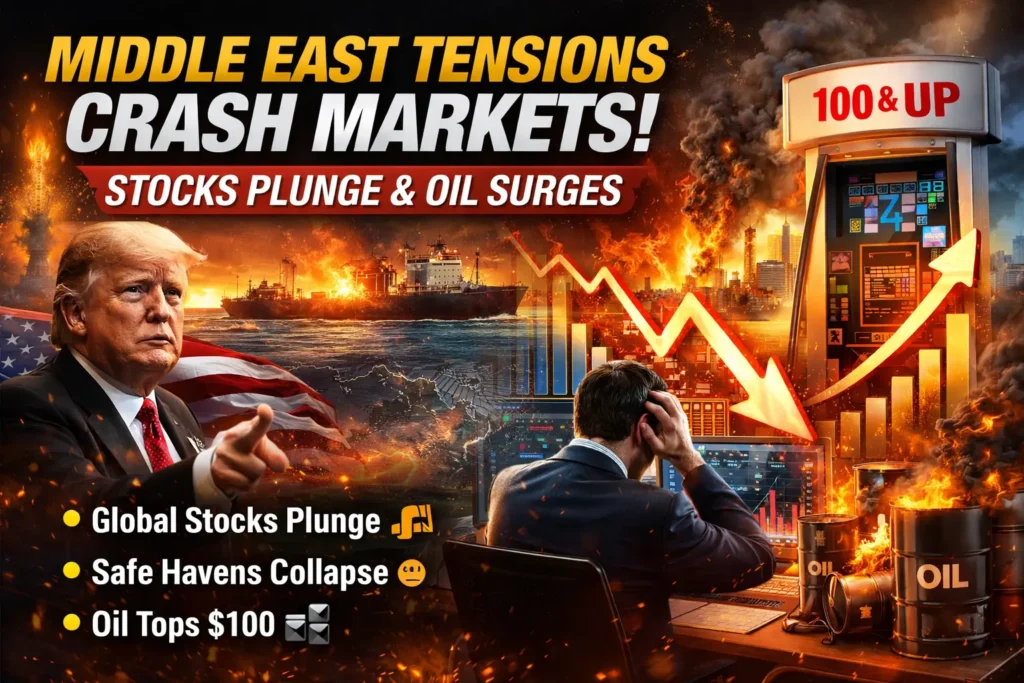
Global financial markets are under intense pressure as geopolitical tensions in the Middle East escalate rapidly. A fresh warning from Donald Trump has triggered widespread uncertainty, sending shockwaves across stocks, commodities, and investor sentiment worldwide.
With a 48-hour ultimatum to Iran over the Strait of Hormuz, fears of a major global conflict are now driving extreme market volatility.
📉 Global Stock Markets in Freefall
Equity markets across Asia and beyond have taken a sharp hit.
Major declines include:
- Nikkei 225 down 3.5%
- KOSPI plunging over 6%
The selloff reflects growing fears that escalating tensions could disrupt global trade, energy supply, and economic stability.
👉 Investors are rapidly pulling money out of equities as uncertainty rises.
🛢️ Oil Prices Surge Above $100
Energy markets are reacting even more dramatically.
- U.S. crude oil has crossed $100 per barrel
- Global benchmarks have surged to $114
The Strait of Hormuz, a critical global oil transit route, is at the center of this crisis. Any disruption here could choke supply and push prices even higher.
Why this matters:
- Increased fuel costs globally
- Higher inflation pressure
- Rising cost of living for consumers
🪙 Safe Haven Assets Are Also Falling
In a surprising twist, traditional safe-haven assets are also seeing declines.
Usually, during crises, investors move to:
- Gold
- Government bonds
But this time, markets are behaving differently.
👉 Investors are:
- Selling gold
- Dumping bonds
- Moving heavily into cash positions
This unusual behavior signals extreme uncertainty and liquidity preference in the market.
📊 Interest Rate Hikes Back in Focus
With oil prices rising and inflation fears growing, central banks may be forced to act.
The Federal Reserve is now expected to:
- Increase interest rates more aggressively
- Maintain tighter monetary policy
This adds another layer of pressure on global markets, especially equities and emerging economies.
🌍 Why the Strait of Hormuz Matters
The Strait of Hormuz is one of the most critical oil chokepoints in the world.
- Nearly 20% of global oil supply passes through it
- Any disruption can trigger global economic shockwaves
That’s why this geopolitical development is not just regional—it’s global in impact.
🎥 Watch the Full Analysis
For a detailed breakdown of this developing situation, watch the original video here:
👉 https://youtu.be/UNkIF7UPSYs?si=S6heD3ZfuXPoaDSk
🔮 What Happens Next?
Markets are now watching closely for:
- Iran’s response to the ultimatum
- Any military escalation
- Central bank policy changes
Possible scenarios:
- ⚠️ Conflict escalation → deeper market crash
- 🛢️ Oil spike → global inflation surge
- 📉 Continued volatility across all asset classes
🧠 Final Thoughts
This situation highlights how quickly geopolitics can shake global markets. From crashing stocks to rising oil and collapsing safe havens, investors are navigating one of the most unpredictable environments in recent times.
The next 48 hours could be crucial—not just for the Middle East, but for the entire global economy.
[2161]rusa4d | Login Link Alternatif Resmi Situs Slot Gacor Terpercaya,rusa4d menyediakan link alternatif resmi untuk akses mudah. Nikmati daftar judi online deposit dana praktis dan panduan cara main casino online. Gabung sekarang! visit: rusa4d
Honestly the best experience I have had in a long time. The rewards are fair and the gameplay is super addictive. Big fan of idminion178