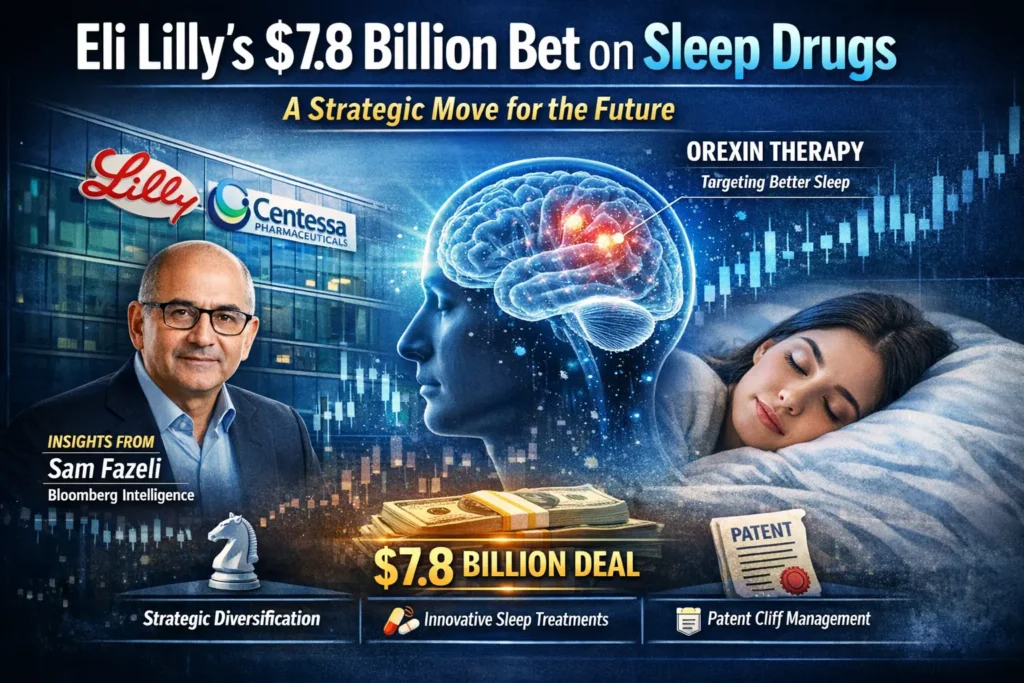
The pharmaceutical giant Eli Lilly is once again making headlines with its $7.8 billion acquisition of Centessa Pharmaceuticals. While this deal may seem modest for a company of Lilly’s scale, industry experts like Sam Fazeli suggest it could play a major role in shaping the company’s long-term growth strategy.
In a recent discussion featured by Bloomberg Intelligence, Fazeli breaks down how this acquisition strengthens Lilly’s position in the competitive pharmaceutical market.
📌 Strategic Diversification into Sleep Disorders
One of the biggest highlights of this deal is Eli Lilly’s entry into the sleep disorder drug market.
Although $7.8 billion might sound massive, for a company like Eli Lilly, it’s considered a relatively small investment—a “drop in the ocean.” However, the importance lies not in the size of the deal, but in its direction.
By acquiring Centessa, Lilly is expanding its neuroscience portfolio, tapping into a growing demand for better sleep treatments. Sleep disorders are increasingly recognized as a major global health issue, making this a high-potential segment.
🌙 A New Era of Sleep Innovation
The acquisition focuses on a new class of drugs targeting orexin receptors, a breakthrough approach in sleep medicine.
Unlike traditional sleeping pills, which often come with side effects like grogginess or dependency, orexin-based treatments aim to:
- Preserve natural sleep cycles
- Maintain REM and deep sleep
- Reduce next-day drowsiness
This innovation could redefine how sleep disorders are treated, positioning Eli Lilly as a leader in next-generation sleep therapeutics.
🛡️ Managing the Patent Cliff Challenge
Like all major pharmaceutical companies, Eli Lilly faces the inevitable challenge of patent expirations, often referred to as the “patent cliff.”
According to Sam Fazeli:
- Eli Lilly is well-protected for the next decade
- Strategic acquisitions like Centessa help cushion future revenue loss
- Diversification ensures long-term stability
This move reflects a common industry strategy where companies invest in new pipelines to offset upcoming patent losses.
📊 Why This Deal Matters
This acquisition highlights three critical trends in the pharmaceutical industry:
- Innovation-driven growth
- Expansion into high-demand therapeutic areas
- Proactive risk management through diversification
For Eli Lilly, it’s not just about entering a new market—it’s about securing its future in an increasingly competitive landscape.
For deeper insights, check out the full video here:
👉 https://youtu.be/big5zRW_sXM?si=e2qIMyjzhczZgTJ9
🔍 Final Thoughts
Eli Lilly’s $7.8 billion acquisition of Centessa may appear small on the surface, but it represents a smart, forward-looking strategy. By entering the sleep disorder market and investing in innovative drug mechanisms, the company is positioning itself for sustained growth while mitigating future risks.
As the pharmaceutical industry evolves, moves like this will separate market leaders from the rest—and Eli Lilly seems determined to stay ahead.
Yo, Jilibet and Donnalyn, huh? Checked out the jilibet play with donalyn login page. If you’re looking to play with Donnalyn on Jilibet, this is probably where you wanna be: jilibet play with donalyn login
Just signed up for okvipas. The site looks pretty promising, offering a range of betting options. Let’s see if they live up to the hype. Joining me? Check it out: okvipas
Into Tai Xiu dice games? Checking out one88taixiu. The interface is clean and easy to understand. Throwing down some bets and hoping for the best rolls. Good luck everyone: one88taixiu
PH23Casino, huh? Name’s kinda catchy. Gonna give it a shot tonight. Anyone else played here before? Let me know what you think! More info: ph23casino
Signed up on 5577, easy peasy! Hoping for some good fortune! Give it a burl if you’re feelin’ lucky! 5577
Having a punt on 662bet1 tonight! Website looks slick. Wish me luck, and you can try it out too! 662bet1
[8891]fastwin77: Login Resmi Situs Slot Gacor dan Casino Terpercaya,fastwin77 menyediakan akses login resmi untuk download apk terbaru. Nikmati kemudahan daftar casino online terpercaya dengan opsi deposit via dana. Gabung sekarang! visit: fastwin77
[7308]buy138 | Login Resmi Link Alternatif Situs Slot Gacor Hari Ini,buy138 menyediakan akses link alternatif terbaru untuk daftar game casino online terlengkap. Nikmati kemudahan cara deposit dana casino yang cepat. Gabung sekarang! visit: buy138