What if the biggest nuclear waste problem in U.S. history could become the next energy breakthrough?
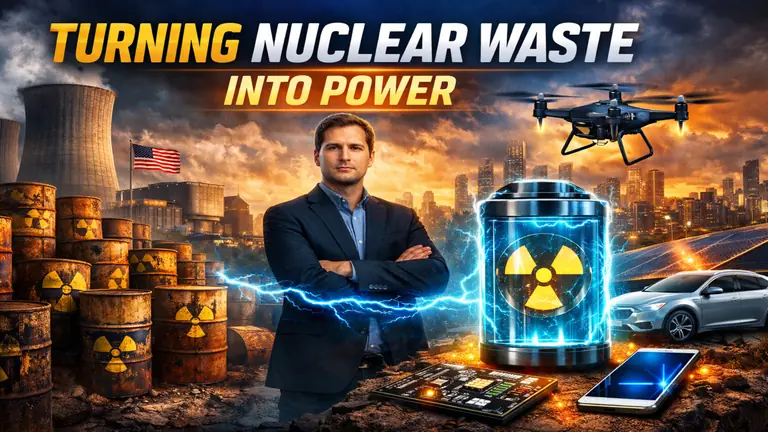
A new startup called Project Omega believes America’s 100,000 tons of spent nuclear fuel isn’t just dangerous waste — it’s a massive, untapped power source. And if their early results hold up, your future phone, drone, or even car could run on nuclear batteries that last for years.
Here’s why investors and the U.S. government are paying attention.
The $100 Billion Nuclear Waste Problem
For decades, the United States has stored spent nuclear fuel with no long-term recycling solution. Yet experts say this “waste” still holds over 90% of its original energy.
As nuclear power expands to meet climate goals, this stockpile is only growing.
Instead of building more storage facilities, Project Omega wants to unlock the energy trapped inside that material.
Turning Radiation Into Electricity
Led by CEO Stafford Sheehan, Project Omega is developing technology to convert nuclear isotopes into long-life power batteries.
Unlike traditional nuclear companies focused on reactors, Omega is targeting:
- Smartphones
- Drones
- Remote sensors
- Military systems
- Government infrastructure
In lab tests, the company says it has already demonstrated the ability to convert radiation into usable electricity — a key step toward commercial products.
If successful, these batteries could last years without charging.
$12 Million Bet on Nuclear Batteries
Investors are backing the idea.
Project Omega has raised $12 million at a $50 million valuation, with funding from:
- Starship Ventures
- Mantis Ventures
- Decisive Point
- Slow Ventures
The startup also secured a contract with ARPA-E, the Department of Energy’s advanced research arm — a strong signal of federal interest in breakthrough energy tech.
A Different Strategy From Competitors
While companies like France’s Orano and several U.S. firms focus on recycling nuclear fuel for new reactors, Project Omega is taking a bold, consumer-facing approach.
Instead of fueling reactors, it wants to power devices directly.
That strategy could open an entirely new market — but it also raises regulatory and public perception challenges.
Could Nuclear Batteries Replace Lithium?
Investors envision a future where nuclear isotope batteries:
- Last significantly longer than lithium-ion
- Reduce battery waste
- Improve energy security
- Power remote or off-grid systems
But scaling the technology safely and gaining public trust will be critical hurdles.
The Bottom Line
America’s nuclear waste has long been viewed as a liability. Project Omega sees it as an opportunity.
If the company can turn spent nuclear fuel into safe, long-life batteries, it could transform both the energy industry and consumer electronics.
The big question:
Will nuclear waste become the next clean energy breakthrough — or remain a storage problem for decades to come?