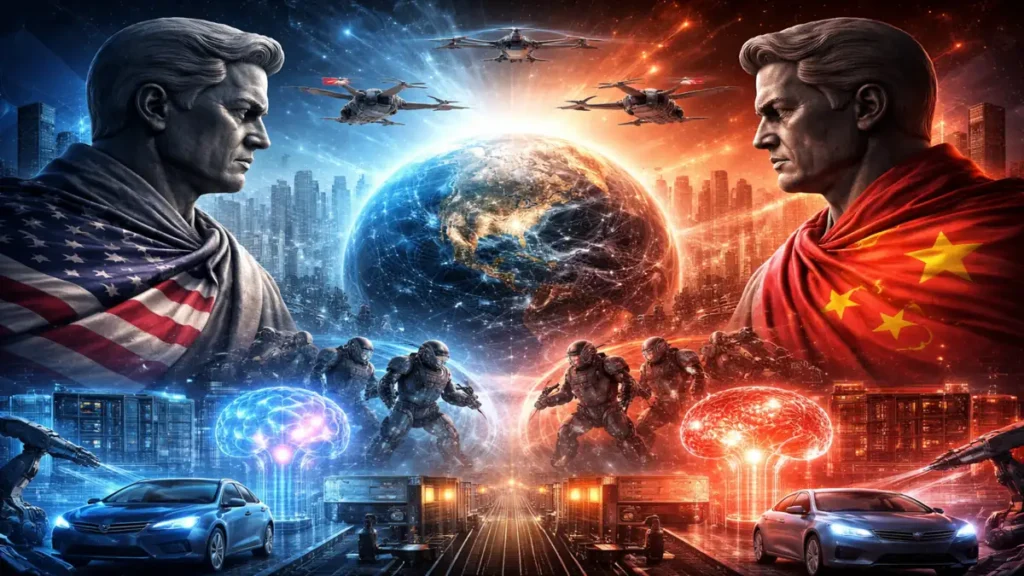
At the World Economic Forum’s annual meeting in Davos, historian Niall Ferguson delivered a sobering yet nuanced assessment of today’s global order. Drawing parallels to past geopolitical eras, Ferguson argues that while history may not repeat itself exactly, it often rhymes — and today’s world feels increasingly like a new Cold War.
Here’s a deep dive into the key themes from his discussion and what they mean for the future.
❄️ “Cold War II” — But Different This Time
Ferguson describes the current U.S.–China rivalry as a form of “Cold War II.”
Unlike the Cold War between the United States and the Soviet Union, however, today’s superpowers are deeply economically intertwined. The U.S. and China share vast trade networks, supply chains, and financial linkages — making this rivalry more complex and potentially more volatile.
The economic integration means decoupling is difficult, yet strategic competition is intensifying in areas such as:
- Artificial Intelligence (AI)
- Semiconductors
- Electric vehicles
- Advanced manufacturing
This combination of rivalry and interdependence creates a fragile global balance.
🤖 AI and the New Technological Dangers
While nuclear weapons remain a lingering threat from Cold War I, Ferguson warns that new technologies like AI may pose even more unpredictable risks.
Artificial intelligence has the potential to:
- Accelerate cyber warfare
- Increase misinformation
- Disrupt economies and labor markets
- Create autonomous military capabilities
Unlike nuclear weapons — which are visible and heavily regulated — AI is rapidly evolving, widely distributed, and difficult to control. This makes today’s strategic competition potentially more dangerous.
🔥 Cultural Polarization and “Political Religions”
Ferguson also highlights growing cultural polarization in Western democracies.
He compares today’s political environment to:
- The American Civil War era
- The ideological tensions of the 1950s and 1960s
- The religious wars that followed the invention of the printing press
Social media platforms, he argues, amplify inflammatory content because their business models reward outrage and division. This has led to what he calls a “hollowing out of the center,” where moderate voices struggle to compete with extreme narratives.
Political allegiances increasingly resemble “political religions,” with strong emotional identities rather than policy-based debates.
🇺🇸 Will Polarization Lead to Civil War?
Despite concerns, Ferguson does not believe the United States is heading toward civil war.
He explains that polarization today is “fractal” — meaning divisions run through families, communities, and workplaces rather than along clear geographic lines.
Additionally:
- A large share of U.S. voters identify as independents
- European democracies operate multi-party systems
- Political loyalties are fluid
This makes a clear two-sided territorial conflict unlikely.
⚔️ The “Age of Competition”
Ferguson rejects the popular term “polycrisis” and instead prefers to describe today as an “Age of Competition.”
Competition, particularly in innovation-driven industries like AI and electric vehicles, can be a powerful force for progress. He draws a historical parallel to Europe after 1600, when intense state competition led to rapid technological advancement.
However, he draws a sharp distinction:
- Economic competition = Good (drives innovation and efficiency)
- Geopolitical competition = Dangerous (can lead to war, as seen in Ukraine and the Middle East)
The challenge is ensuring rivalry stays within economic bounds rather than escalating into military confrontation.
🌋 The Overlooked Black Swans: Geological Disasters
One of Ferguson’s most surprising warnings involves underappreciated risks — major geological events.
While climate change dominates public discussion, Ferguson notes that:
- Massive volcanic eruptions
- Major earthquakes
- Tsunami events
could cause catastrophic economic and human losses, especially in densely populated urban areas near fault lines.
These “black swan” events receive less policy attention but may be deadlier than many anticipated crises.
🌅 Reasons for Optimism
Despite outlining numerous risks, Ferguson offers two strong reasons for optimism.
1️⃣ Historical Perspective
Compared to World War II or the peak of the original Cold War, today’s global tensions are less severe. Humanity has faced far worse — and survived.
2️⃣ Individual Empowerment Through Technology
Perhaps most importantly, modern technology empowers individuals like never before.
The internet provides:
- Global access to knowledge
- Entrepreneurial opportunities
- Cross-border collaboration
- Creative freedom
Ferguson argues that technological revolutions ultimately favor individual liberty over totalitarian control. Talented individuals, regardless of background, now have unprecedented tools to fulfill their potential.
Final Thoughts
Niall Ferguson’s analysis at Davos presents a balanced but cautionary view of the modern world.
We may indeed be living in a new Cold War — one defined by AI, economic interdependence, and intense global competition. Cultural polarization and geopolitical tension pose serious risks.
Yet history suggests resilience, and technological empowerment offers hope.
The key question for the coming decade:
Will competition remain a driver of innovation — or spiral into conflict?
The answer may define the 21st century.