Europe faces a “Second China Shock” as Chinese EV and auto exports pressure Germany’s manufacturing sector. Learn how this shift compares to the US experience and what comes next.
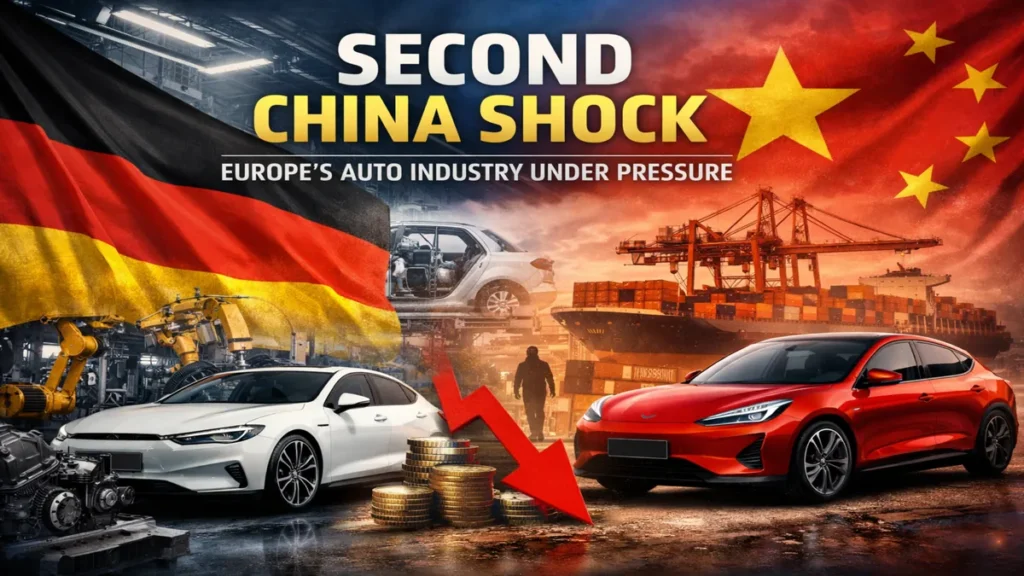
Europe may be entering a defining economic moment often described as the “Second China Shock”—a wave of competitive pressure driven by China’s rapidly evolving export machine. Much like the first China shock that reshaped American manufacturing in the early 2000s, this new phase is now hitting Europe, with Germany’s auto industry at the epicenter.
Germany’s Auto Industry Under Strain
Germany’s automotive sector, long considered the backbone of the country’s economy, is facing mounting challenges from China’s dominance in electric vehicle (EV) supply chains. European manufacturers are struggling to access advanced battery technologies and critical raw materials, while facing fierce competition from a growing number of Chinese original equipment manufacturers (OEMs).
Martin Books, CEO of the Yope Group, illustrates the real-world impact of this shift. His company was forced to close multiple plants and lay off around 500 workers after production programs were postponed and volumes sharply declined—clear signs of structural pressure rather than a short-term slowdown.
Lessons From the First China Shock in the US
To understand what’s unfolding in Europe, economists point to the US experience after China joined the World Trade Organization in 2001. According to David Autor, an economist at MIT, Chinese import competition displaced large portions of US manufacturing, accounting for nearly 60% of manufacturing job losses between 2001 and 2019.
Autor argues the US failed to soften the blow through gradual transitions or strong social policies, leaving entire regions economically hollowed out—an outcome Europe is now eager to avoid.
Europe’s Own “Second China Shock”
Today, a similar dynamic is emerging across Europe. Surging Chinese exports—particularly in automobiles and EV components—are threatening to displace domestic production. Germany, given its heavy reliance on auto manufacturing, is especially vulnerable.
However, this second shock differs in important ways.
Why This Time Might Be Different
Stephanie Flanders of Bloomberg News notes that China has adapted strategically. While US tariffs reduced exports to America, China redirected trade toward Europe, Africa, and other regions—often cutting prices to stay competitive.
Unlike two decades ago, China is no longer just exporting low-cost, labor-intensive goods. It has climbed the value chain and now competes directly in high-tech manufacturing, including advanced auto supply systems and electric vehicles that rival Western standards.
How German Firms Are Adapting
Facing these pressures, some German companies are pivoting away from sectors dominated by Chinese manufacturing. Martin Books’ firm is expanding into defense and space, leveraging expertise in mechanics and mechatronics.
This shift aligns with Germany’s increased defense spending, which is providing a fiscal boost to parts of the economy and creating alternative growth channels outside traditional automotive manufacturing.
Broader Economic Impact on Europe
There is a paradoxical upside to cheaper Chinese imports. Lower-priced goods are helping to pull down inflation in parts of Europe, easing cost pressures on consumers. This trend could reduce the need for aggressive interest rate cuts by the European Central Bank, offering policymakers more flexibility.
Final Takeaway
The “Second China Shock” is not a repeat of the past—but it is no less disruptive. While the products, regions, and economic context have changed, the impact on specific sectors and communities in Europe—especially Germany’s auto industry—will be profound.
How effectively Europe adapts through industrial strategy, diversification, and social policy may determine whether this shock becomes a crisis—or a catalyst for reinvention.