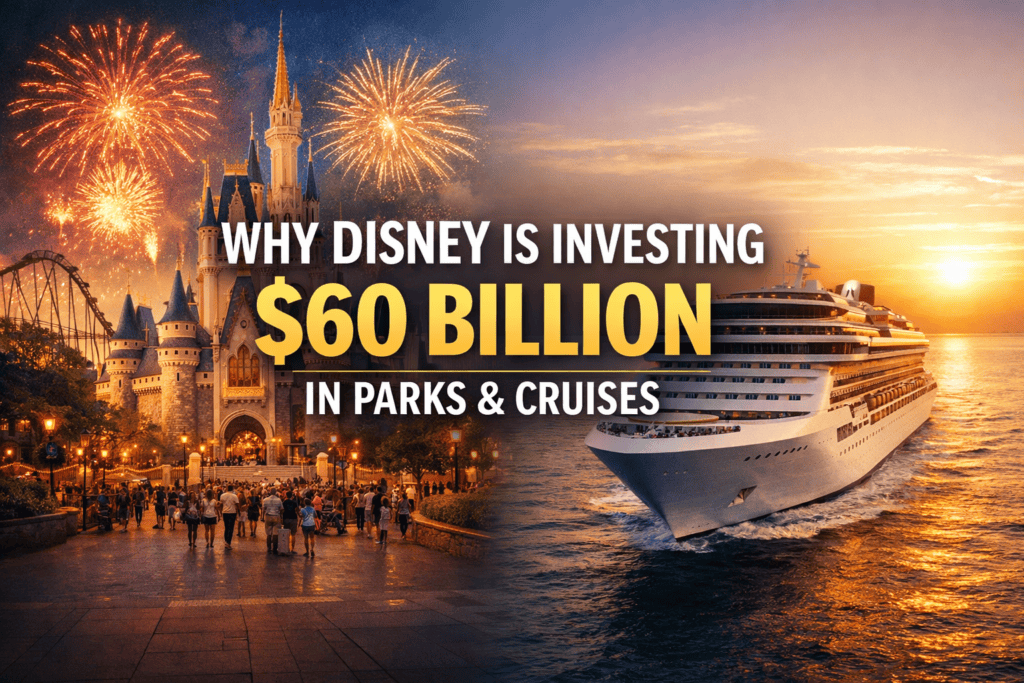
Disney’s $60 Billion Bet on Theme Parks and Cruise Growth
The Walt Disney Company is making a long-term wager that its future growth will come less from screens and more from physical experiences.
Over the next decade, Disney plans to invest $60 billion in its theme parks, cruise ships, and experiences division—an area that has quietly overtaken television and streaming as the company’s largest source of operating profit.
The move reflects a broader recalibration inside Disney as traditional media businesses face structural challenges and investors demand more predictable returns.
Experiences Have Become Disney’s Most Reliable Business
For years, Disney’s identity was built around film studios, cable networks, and television advertising. That model has weakened as cable subscriptions decline and streaming platforms struggle to achieve sustained profitability.
In contrast, Disney’s parks and experiences unit has emerged as a steady earnings engine. Attendance has remained resilient, pricing power has increased, and margins have expanded as the company leans into premium offerings, reservation systems, and higher-spending visitors.
Theme parks and cruises now generate a disproportionate share of Disney’s cash flow relative to their revenue contribution—making them central to the company’s financial stability.
The Internal Team Driving the $60 Billion Expansion
Much of the investment will be directed by Disney’s Imagineering and experiences leadership—a group responsible for designing attractions, expanding resorts, and integrating technology into guest operations.
Their mandate extends beyond building new rides. The strategy includes:
- Expanding park capacity globally
- Launching new cruise ships and routes
- Using technology to personalize pricing and guest experiences
- Improving infrastructure to support higher per-guest spending
This team operates largely behind the scenes but plays a critical role in translating Disney’s intellectual property into long-lived, monetizable assets.
Why Parks Look More Attractive Than Media Right Now
From a financial perspective, theme parks offer several advantages over media businesses:
- Revenue is less sensitive to advertising cycles
- Customers pay upfront, improving cash flow visibility
- Assets can generate returns for decades
- Competition is limited due to high capital requirements
By contrast, television and streaming require continuous spending on content with uncertain returns. Even successful shows often fail to deliver long-term profitability.
Disney’s investment signals a belief that experiences provide a more defensible business model in an era of fragmented media consumption.
What the Bet Means for Investors
For shareholders, the $60 billion commitment suggests Disney is prioritizing durable earnings over rapid subscriber growth.
The strategy may not deliver explosive short-term gains, but it could:
- Stabilize earnings through economic cycles
- Offset volatility in media businesses
- Reinforce Disney’s competitive moat
It also aligns Disney with a broader corporate trend: companies are increasingly investing in assets that produce recurring, experience-driven revenue rather than purely digital growth.
The Bottom Line
Disney’s future may hinge less on what audiences watch at home and more on where they choose to spend their time—and money—in person.
By doubling down on theme parks and cruises, The Walt Disney Company is signaling that physical experiences, not television, will anchor its growth strategy for the next decade.
For now, investors appear to be watching closely to see whether this capital-intensive bet delivers the steady returns Disney is counting on.