How Bitcoin is gaining momentum through institutional inflows while DeFi faces rising security risks. Insights from Scott Melker on market trends, stablecoins, and crypto vulnerabilities.
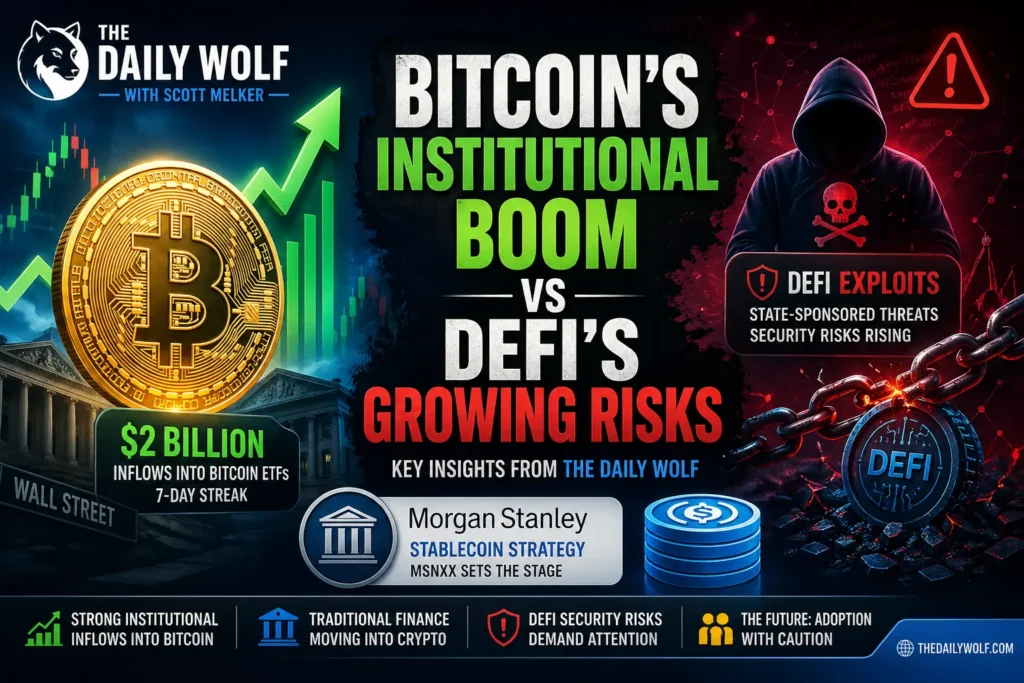
The cryptocurrency market is entering a critical phase where institutional confidence is rising rapidly, but structural risks—especially in decentralized finance—remain unresolved. In a recent episode of The Daily Wolf, crypto analyst Scott Melker explores this contrast, offering valuable insights for investors navigating today’s market.
Bitcoin Gains Strength Through Institutional Inflows
Bitcoin is currently benefiting from a surge in institutional demand. Over a short span of time, nearly $2 billion has flowed into spot Bitcoin ETFs, signaling strong confidence from large investors.
Companies like MicroStrategy continue to accumulate Bitcoin aggressively, reinforcing the long-term bullish narrative.
Why This Matters:
- Institutional buying is outpacing Bitcoin’s new supply
- Increased demand could push prices toward $80,000
- ETFs are making Bitcoin more accessible to traditional investors
👉 The trend is clear: Bitcoin is evolving into a mainstream financial asset.
Prediction Markets Raise Ethical Concerns
The episode also highlights a controversial case involving insider trading in prediction markets, where privileged information was used for betting.
This raises key issues:
- Lack of fair access to information
- Ethical concerns in emerging financial systems
- Growing need for regulatory oversight
👉 As financial innovation expands, so do challenges around fairness and transparency.
Morgan Stanley Enters the Stablecoin Arena
Morgan Stanley is stepping into the crypto space with its treasury solution, MSNXX, aimed at managing stablecoin reserves.
Potential Impact:
- Banks could regain control over crypto liquidity infrastructure
- Stablecoins may become more integrated with traditional finance
- Institutional trust in crypto systems could increase
👉 This signals a shift where traditional finance is not competing with crypto—but integrating into it.
DeFi Security Risks Continue to Grow
Despite the optimism around Bitcoin, the DeFi sector faces serious security challenges.
Major institutions like:
- JPMorgan Chase
- Jefferies
have issued warnings about vulnerabilities in DeFi platforms.
Key Risks:
- Smart contract exploits and hacks
- Increasing attacks from groups like Lazarus Group
- Lack of robust security infrastructure
👉 These risks may slow institutional adoption of DeFi until stronger safeguards are in place.
Final Analysis
The crypto market today reflects a split narrative:
📈 Positive Signals
- Strong institutional inflows into Bitcoin
- Growing adoption through ETFs
- Increased involvement from global financial institutions
📉 Ongoing Risks
- DeFi security vulnerabilities
- Regulatory uncertainty
- Ethical concerns in new financial tools
❓ Frequently Asked Questions (FAQs)
1. Why is Bitcoin rising despite market uncertainty?
Bitcoin is gaining momentum due to strong institutional inflows, especially through ETFs and large corporate investments.
2. What role do institutions play in crypto markets?
Institutions provide liquidity, stability, and legitimacy, helping crypto assets move closer to mainstream adoption.
3. Is DeFi safe for investors?
DeFi offers high returns but carries risks such as hacks, smart contract bugs, and lack of regulation.
4. What is Morgan Stanley’s role in crypto?
Morgan Stanley is developing tools to manage stablecoin reserves, aiming to integrate traditional finance with crypto systems.
5. Who is behind major DeFi hacks?
Some attacks are linked to groups like Lazarus Group, known for sophisticated cyber operations.
Conclusion
The future of crypto is being shaped by two opposing forces:
institutional growth and technological risk.
While Bitcoin continues to strengthen its position as a trusted asset, DeFi must overcome security challenges to gain similar confidence.
999bd
August 19, 2026 at 3:02 pm[3427]999bd Official Login – সেরা অনলাইন ক্যাসিনো ও দ্রুত বিকাশ পেমেন্ট,999bd-এ আজই যোগ দিন। এখানে পাবেন সেরা অনলাইন স্লট গেমের নিয়ম এবং দ্রুত বিকাশ পেমেন্টের সুবিধা। এখনই অ্যাপ ডাউনলোড করে গেমিং শুরু করুন। visit: 999bd
MichaelAdush
September 14, 2026 at 2:17 amВоздуходувные устройства и измельчители Stihl
okplaycasinoapk
October 8, 2026 at 2:48 pmThe app is a game changer. I can play wherever I am and the graphics are stunning. You guys should definitely try okplaycasinoapk.
phjili123
October 13, 2026 at 12:19 pmSuper honest site with great bonuses for new players. I had a great time exploring the games on phjili123 today.
magnum188link
October 17, 2026 at 4:08 amSearching for a working link can be a pain but this one is perfect. Everything is streamlined and works exactly as expected. Great job on magnum188link.
cipung138login
October 19, 2026 at 4:56 amI’ve been looking for a reliable way to access my account and this site makes it so easy. Everything loads quickly and the interface is super smooth. Definitely the best choice for cipung138login.