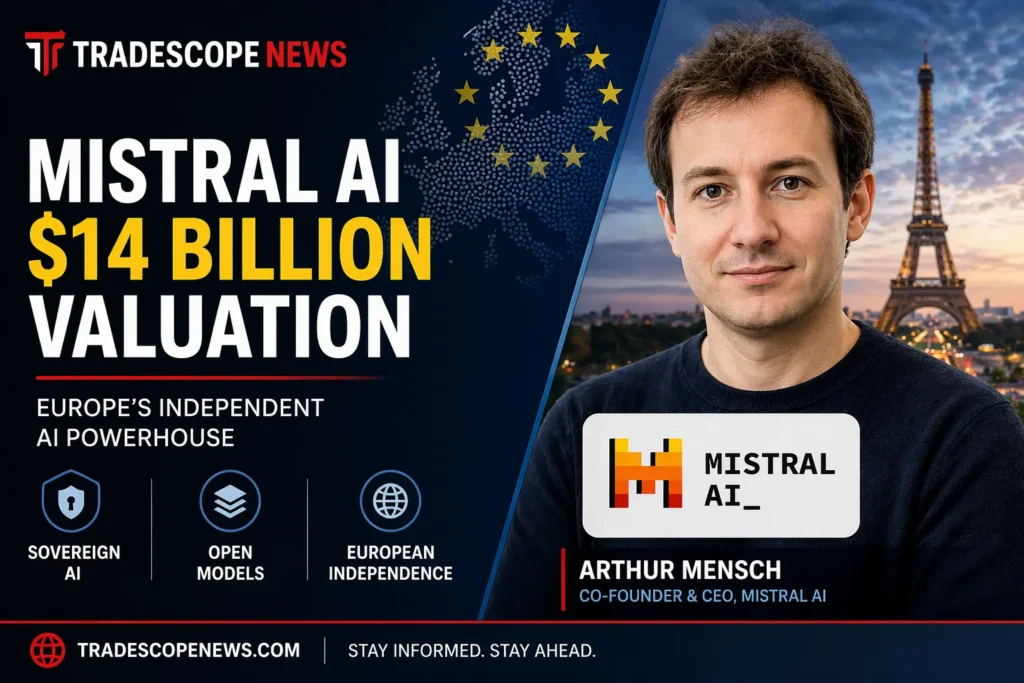
In the rapidly evolving world of artificial intelligence, a new European contender is making serious waves. Paris-based Mistral AI has surged to a remarkable $14 billion valuation—not by beating competitors in raw performance, but by redefining what businesses and governments truly need from AI.
While industry giants like OpenAI and Anthropic dominate performance benchmarks, Mistral is carving out a powerful niche centered on independence, sovereignty, and flexibility.
The Rise of Sovereign AI
At the core of Mistral’s success is a simple but powerful idea: control matters more than raw power.
CEO Arthur Mensch emphasizes that many governments and enterprises are increasingly uncomfortable relying on American or Chinese tech giants. Concerns around data privacy, regulatory restrictions, and geopolitical tensions are pushing organizations to seek alternatives.
Mistral addresses this demand by offering sovereign AI solutions—allowing users to run models locally, offline, or within their own infrastructure. This ensures that sensitive data never leaves their control.
Open-Weight Models: A Game-Changer
Unlike the “black box” approach used by many competitors, Mistral champions an open-stack philosophy.
Its open-weight models give companies the ability to:
- Customize AI systems to their needs
- Deploy solutions in secure, private environments
- Maintain full transparency over how models operate
This flexibility is especially appealing to industries like finance, healthcare, and government sectors, where compliance and security are critical.
Geopolitical Momentum Driving Growth
Mistral’s growth isn’t just about technology—it’s also about timing.
With rising global tensions, trade disputes, and tighter regulations on American tech companies, European businesses are actively seeking homegrown alternatives. Mistral’s “proudly European” identity positions it perfectly to benefit from this shift.
This geopolitical tailwind has significantly boosted its appeal across Europe and beyond.
Revenue Growth and Future Outlook
Despite not being profitable yet—largely due to high compute and data costs—Mistral is scaling rapidly.
- 2025 Revenue: $200 million
- Growth Strategy: Expanding enterprise adoption and increasing monthly recurring revenue
The company’s trajectory suggests that profitability may not be far off, especially as demand for sovereign AI continues to rise.
Why Mistral’s Strategy Works
Mistral’s success highlights an important shift in the AI industry:
The future of AI isn’t just about who builds the most powerful model—it’s about who builds the most trusted one.
By focusing on independence, transparency, and control, Mistral has positioned itself as a serious global competitor—even without leading benchmark scores.
Frequently Asked Questions (FAQs)
1. What is Mistral AI?
Mistral AI is a Paris-based artificial intelligence company focused on building open-weight AI models and sovereign AI solutions for enterprises and governments.
2. How is Mistral different from OpenAI and Anthropic?
Unlike competitors that offer closed, black-box models, Mistral provides open-weight models that allow users to customize and deploy AI within their own infrastructure.
3. What does “sovereign AI” mean?
Sovereign AI refers to systems that can be controlled and operated independently—often locally or on private servers—ensuring full data privacy and compliance with local regulations.
4. Is Mistral profitable?
As of 2025, Mistral is not yet profitable due to high infrastructure costs, but it has generated around $200 million in revenue and is growing rapidly.
5. Why is Mistral gaining popularity in Europe?
Geopolitical concerns, data privacy regulations, and a desire to reduce reliance on foreign tech companies have made Mistral an attractive European alternative.
6. What is an open-weight AI model?
An open-weight model allows developers to access and modify the model’s parameters, enabling customization and deployment in secure, private environments.
cvtogel
August 20, 2026 at 5:56 am[7757]CVTOGEL | Login Resmi Link Alternatif Situs Slot Gacor Terpercaya,CVTOGEL menyediakan akses login resmi dan link alternatif terbaru. Nikmati kemudahan daftar casino deposit pulsa serta berbagai pilihan slot gacor. Gabung sekarang! visit: cvtogel
yooe777download
August 29, 2026 at 5:47 pmFinally found a place where the app installs without any glitches. The loading speed is impressive and the gameplay is top-notch. Just get the yooe777download and start playing.
dk1947game
September 7, 2026 at 2:21 amFinally found a site that actually delivers on its promises. The gameplay is addictive and the bonuses are quite generous. Give dk1947game a try!
nbajjecasino
September 25, 2026 at 7:42 pmThe game variety here is insane! I love how fast the payouts are processed. Highly recommend nbajjecasino to anyone looking for some real excitement.
bdbk66game
October 16, 2026 at 7:29 pmThe graphics are super smooth and the games are really addictive. Highly recommend it to anyone looking for some fun. bdbk66game