Singapore has transformed from a small colonial-era trading port into one of Asia’s most important manufacturing, financial and business hubs. But as Prime Minister Lawrence Wong leads the country into a new phase, Singapore faces a different set of challenges: an ageing population, low fertility, housing and cost-of-living pressures, a changing global economy and continuing debate over civil liberties.
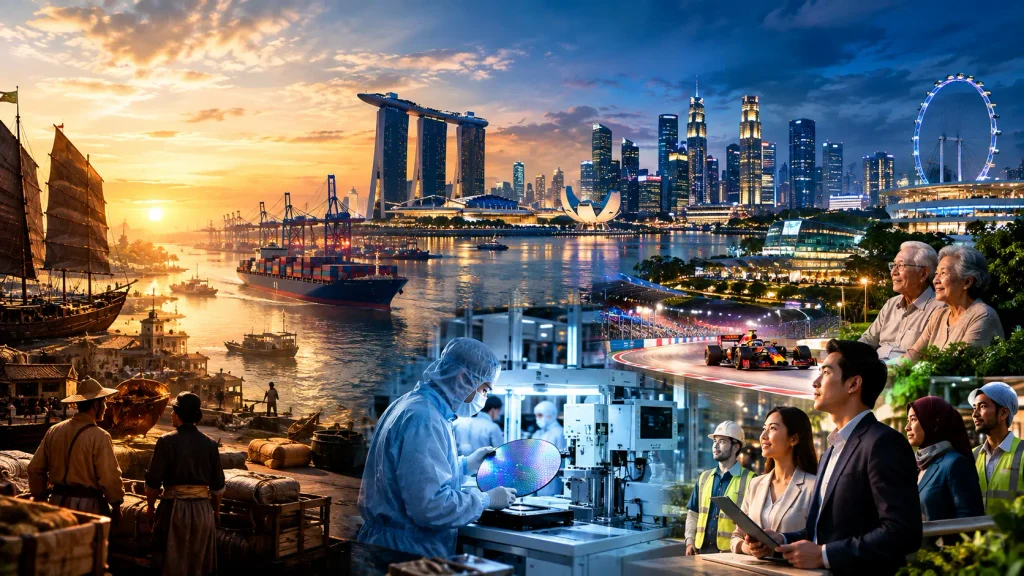
The city-state has few natural resources, a small domestic market and limited land. Yet over several decades it developed world-class infrastructure, attracted multinational companies and built major manufacturing, financial and tourism industries.
The foundations of that transformation were laid during the country’s early decades of self-government and independence. Today, the economic model is entering another period of adjustment as Singapore responds to demographic change, geopolitical uncertainty and a more fragmented global economy.
From Trading Port to Industrial Economy
When Singapore became independent in 1965, its economic position was very different from today.
The country had no large natural-resource base and faced high unemployment. The government therefore placed strong emphasis on industrialisation and attracting foreign investment.
Singapore developed industrial estates, invested heavily in infrastructure and worked to attract multinational corporations.
The Singapore Economic Development Board describes manufacturing as a central part of the country’s economic development. Early industrialisation included labour-intensive industries before the economy moved toward higher-value sectors such as electronics, petrochemicals, precision engineering and biomedical manufacturing.
That strategy helped create jobs while simultaneously building Singapore’s capabilities as an international production and logistics centre.
Today, manufacturing remains an important pillar of the economy, accounting for roughly one-fifth of GDP according to Singapore’s Economic Development Board.
The Importance of Infrastructure and Institutions
Singapore’s economic development was not based on manufacturing alone.
The country also invested heavily in transport, ports, utilities, education, housing and other infrastructure while developing institutions intended to provide a predictable environment for businesses.
For multinational companies, these factors matter because investment decisions depend on more than tax rates.
Businesses also consider:
- Infrastructure
- Access to international markets
- Skilled workers
- Legal and regulatory frameworks
- Political and economic stability
- Connectivity
- Tax arrangements
- Availability of regional headquarters services
Singapore has subsequently positioned itself as a regional headquarters and business hub. The EDB says global companies use the country as a base for regional operations because of its connectivity, talent pool, infrastructure and business environment.
The Rise of Singapore as a Financial Centre
Singapore’s economic transformation also involved a major expansion of financial and professional services.
Over time, the city-state developed into a major Asian centre for banking, wealth management, capital markets and other financial activities.
Its location at the crossroads of major Asian trade routes gave it an additional advantage.
The country’s strategy has also included tax incentives and investment policies designed to attract international businesses. The EDB notes that Singapore uses tax incentives as part of a broader strategy to attract substantive economic activity and investment.
This created a feedback loop.
More international companies created demand for financial, legal, accounting, technology and professional services. Those services, in turn, made Singapore more attractive to additional multinational companies.
Tourism Became Another Economic Engine
Singapore has also deliberately developed its tourism and leisure economy.
The city-state has invested in major attractions, entertainment districts, convention facilities and large international events.
One of the most visible examples is the Singapore Grand Prix.
The Singapore Grand Prix became the world’s first Formula 1 night race when it debuted in 2008. The Singapore Tourism Board says the race has generated significant tourism activity and has attracted hundreds of thousands of international visitors over its history.
The significance goes beyond Formula 1.
Large international events can generate spending across hotels, restaurants, transportation, retail, entertainment and business services.
This is an example of Singapore’s broader economic strategy: use limited land and resources to create high-value economic activity.
A New Phase Under Lawrence Wong
Singapore’s leadership transition is now complete.
Lawrence Wong became Prime Minister on 15 May 2024, succeeding Lee Hsien Loong. He is also Singapore’s Minister for Finance.
Wong’s government is operating in an economic environment that differs from the one faced during Singapore’s earlier development.
The country remains highly integrated into global trade, which creates opportunities but also exposes it to international shocks.
In his 2026 New Year message, Wong said Singapore recorded stronger-than-expected growth of 4.8% in 2025, while warning that sustaining such growth would be difficult as geopolitical tensions and trade fragmentation increase.
The Singapore EDB currently describes the country’s 2026 growth outlook as 2% to 4%, based on the Ministry of Trade and Industry’s February 2026 forecast.
Challenge No. 1: An Ageing Population
One of Singapore’s most important long-term economic challenges is demographics.
Like many advanced economies, Singapore has an ageing population and a very low fertility rate.
Singapore’s Department of Statistics reported that the resident total fertility rate was 0.97 in 2024, remaining far below the replacement level.
An ageing population can create pressure on several parts of the economy:
- Healthcare spending
- Retirement systems
- Workforce availability
- Tax revenues
- Social support
- Long-term economic growth
The government has therefore placed greater emphasis on supporting families, improving retirement adequacy and enabling older Singaporeans to remain economically active.
Wong’s government has specifically identified ageing, declining birth rates and longer lifespans as major long-term issues.
Challenge No. 2: Housing and Cost of Living
Economic success can create its own pressures.
As incomes, land values and demand for housing rise, affordability becomes an important issue.
Singapore’s government has acknowledged concerns surrounding housing and has pointed to increased housing supply as part of its response. In a 2025 speech, Wong said the government planned to build ahead of demand and reduce waiting times for some new public housing.
Cost-of-living pressures also remain part of the broader economic debate.
For households, the key issue is not simply whether the economy is growing. It is whether wages, housing costs, healthcare expenses and everyday prices are moving in a way that allows households to maintain or improve their standard of living.
Challenge No. 3: Foreign Labour and Jobs
Singapore’s open economy depends heavily on international talent and foreign workers.
That creates an economic trade-off.
Foreign workers can help companies fill labour shortages and support economic activity. At the same time, concerns can arise among local workers about competition for jobs, wages and opportunities.
This is especially important for a small economy where the domestic workforce is limited.
The government therefore faces the challenge of maintaining Singapore’s attractiveness to international talent while ensuring that local workers can continue to improve their skills and incomes.
Challenge No. 4: Civil Liberties and Political Debate
Singapore’s economic model exists alongside a political and legal environment that has attracted international scrutiny.
Freedom House’s 2025 assessment classified Singapore as “Partly Free” and highlighted restrictions affecting freedom of expression, assembly and association. These are the organization’s assessments, not a consensus description shared by all governments or observers.
This creates an important distinction when discussing Singapore.
The country’s economic performance and governance model can be analysed separately from debates about political freedoms.
Supporters of Singapore’s approach often point to stability, institutional capacity and long-term policymaking. Critics, including international rights organisations, focus on restrictions involving political expression, media and public assembly.
A balanced analysis should distinguish these perspectives rather than treating either interpretation as an undisputed fact.
The Global Economy Is Changing
Perhaps the biggest external challenge for Singapore is that the global economic environment is becoming less predictable.
Singapore depends heavily on international trade and investment.
That means changes in:
- Global tariffs
- Supply chains
- Interest rates
- Energy prices
- Technology
- Geopolitical relationships
- Semiconductor demand
can have an outsized impact on the economy.
In his 2026 New Year message, Wong described global trade fragmentation and geopolitical tensions as longer-term challenges rather than temporary disruptions.
The government’s response has included efforts to strengthen advanced manufacturing, digital capabilities, innovation, workforce skills and energy resilience.
Singapore’s Next Economic Chapter
The next phase of Singapore’s development may look different from its first.
The country can no longer depend primarily on low-cost manufacturing or simply attracting companies through infrastructure.
Instead, it is increasingly competing in areas such as:
- Semiconductors
- Advanced manufacturing
- Artificial intelligence
- Financial services
- Biotechnology
- Digital services
- Regional headquarters
- Green technology
The EDB says Singapore continues to attract investment commitments in advanced manufacturing and positions itself as a regional hub for companies seeking stability, connectivity and access to Southeast Asian markets.
What Investors Should Watch
Singapore’s economic story is particularly relevant to investors because the country’s strengths and vulnerabilities are closely connected.
Strengths
Singapore has:
- Strong international connectivity
- A highly developed financial sector
- Advanced infrastructure
- A significant manufacturing base
- A large multinational corporate presence
- A strategic location in Southeast Asia
Risks
At the same time, investors need to consider:
- An ageing population
- Very low fertility
- Exposure to global trade
- Geopolitical tensions
- Energy dependence
- Global interest-rate conditions
- Competition from other Asian financial and manufacturing centres
These factors do not automatically determine future economic performance. They are variables that could influence Singapore’s growth trajectory.
What’s Next for Singapore?
Singapore’s economic story is moving from rapid development to long-term adaptation.
The challenge for the country’s leadership is no longer simply creating jobs and attracting investment. It is maintaining productivity and competitiveness while dealing with an ageing society, demographic pressures and changing global trade patterns.
Wong’s government has also emphasized housing, healthcare, retirement adequacy and support for families as important domestic priorities.
Meanwhile, Singapore continues to position itself as a trusted base for global companies operating across Asia.
That combination—economic openness externally and social adaptation internally—will be central to the country’s next chapter.
In Simple Terms
Singapore’s transformation was built on several interconnected strategies: industrialisation, foreign investment, infrastructure, education, financial services and international trade.
The country successfully moved from a trading-port economy toward advanced manufacturing and high-value services.
But the challenges have changed.
Singapore now has to manage an ageing population, low fertility, housing and cost-of-living concerns, competition for jobs and skills, and an increasingly uncertain global economy.
The central economic question for the next decade is therefore not simply whether Singapore can continue to grow.
It is whether the country can remain competitive while ensuring that economic growth continues to translate into broad improvements in living standards.
Key Takeaways
- Singapore transformed from a trading-port economy into a diversified global business hub.
- Manufacturing remains an important part of the country’s economy.
- Foreign investment and multinational corporations have played a major role in its development.
- Financial services and tourism have become important economic pillars.
- Lawrence Wong became Prime Minister in May 2024 and is leading Singapore during a new phase of economic and demographic challenges.
- Singapore’s fertility rate remains very low, while population ageing is increasing pressure on healthcare, retirement and the workforce.
- Global trade fragmentation and geopolitical uncertainty are major risks for a highly open economy.
- International organisations continue to debate Singapore’s restrictions on political expression, media and public assembly.
Frequently Asked Questions
Why is Singapore so economically successful?
Singapore’s development has been associated with industrialisation, infrastructure investment, foreign direct investment, international trade, human-capital development and the growth of financial and business services.
What industries are important to Singapore?
Important sectors include advanced manufacturing, electronics, semiconductors, financial services, logistics, biotechnology, tourism and business services.
Who is Singapore’s current Prime Minister?
Lawrence Wong is Singapore’s current Prime Minister and Minister for Finance. He became Prime Minister on 15 May 2024.
What is Singapore’s biggest demographic challenge?
Singapore has an ageing population and a very low fertility rate. These trends can affect the future workforce, healthcare requirements and retirement spending.
Why is Singapore important to multinational companies?
Its connectivity, infrastructure, skilled workforce, business ecosystem and access to Asian markets have helped make it a major regional headquarters and investment location.
What are the main risks to Singapore’s economy?
Key risks include global trade disruptions, geopolitical tensions, demographic ageing, energy costs, changes in global demand and increasing competition between international business hubs.
kkclubonlineplay
September 22, 2026 at 2:01 amThe community here is great and the bonuses are actually worth it. I had a blast playing last night. Definitely visit kkclubonlineplay.
cb777gamedownload
September 25, 2026 at 5:44 amFinally found a place where the download process is actually fast and safe. No more jumping through hoops to get my games. Just head over to cb777gamedownload and get started.