Tesla’s Cybercab is now carrying passengers in Austin. Here’s what Sawyer Merritt and Kevin O’Connor experienced, from the smooth cabin to FSD technology, pricing ambitions and Tesla’s robotaxi strategy.
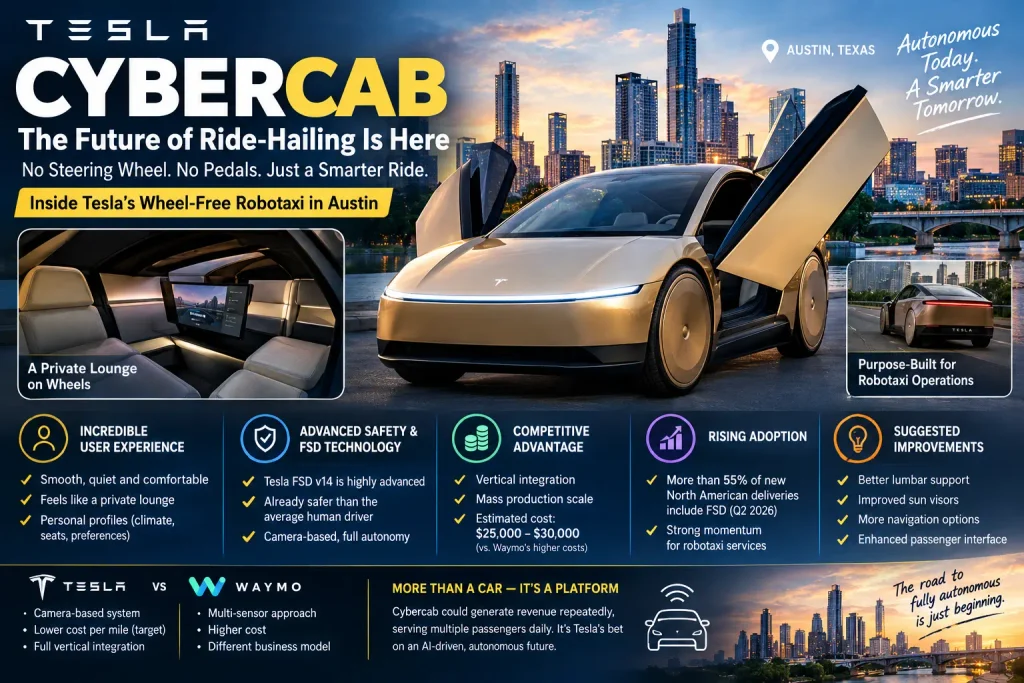
Tesla’s long-awaited Cybercab robotaxi has moved from concept to real-world passenger service in Austin, Texas.
The purpose-built autonomous vehicle is fundamentally different from a conventional Tesla. It has been designed specifically for robotaxi operations and, in its normal configuration, has no steering wheel or traditional pedals.
Tesla describes the Cybercab as a two-passenger autonomous vehicle with a central touchscreen, butterfly doors and a cabin designed around the passenger rather than a human driver. Tesla’s current rider information confirms that Cybercab rides are available in limited areas of Austin.
That unusual design was the focus of a recent discussion involving Tesla commentator Sawyer Merritt and Kevin O’Connor, who shared their experiences riding the vehicle in Austin.
A Ride Designed More Like a Private Lounge
One of the biggest impressions from the discussion was the passenger experience.
Rather than feeling like a conventional car ride, the Cybercab was described as quiet, smooth and highly automated, with the cabin designed around the passenger.
Tesla’s own specifications show the vehicle is a compact two-seater with a large center touchscreen and substantial passenger space. The company lists approximately 43.4 inches of legroom and 20.2 cubic feet of trunk capacity.
The absence of a steering wheel and pedals also changes the visual character of the interior.
Passengers are no longer sitting inside a car designed around someone else’s driving position. Instead, the vehicle is effectively designed as a small autonomous transportation cabin.
Personal Profiles Can Follow Passengers
Another feature highlighted in the discussion is the integration between Tesla’s software and the passenger experience.
Tesla says passenger preferences such as climate settings and seat position can be saved in the Robotaxi profile and carried over between rides. Entertainment features are also available through the vehicle’s touchscreen and Robotaxi app.
That creates a potentially important distinction between traditional taxis and autonomous ride-hailing.
Instead of simply ordering a vehicle, passengers could eventually have a personalized transportation environment that follows them from one trip to another.
No Steering Wheel, No Pedals: How Does Cybercab Drive?
The Cybercab’s most obvious technological feature is what it doesn’t have.
There is no conventional steering wheel, accelerator pedal or brake pedal.
Tesla says the vehicle is designed for full autonomy and uses camera vision and sensors to navigate roads, intersections and parking areas.
The vehicle is therefore built around the assumption that the software—not a human passenger—is responsible for driving.
This is a major departure from Tesla’s existing consumer vehicles, where Full Self-Driving technology still operates within a vehicle equipped for human driving.
Tesla’s FSD Technology Is Central to the Strategy
Tesla’s broader autonomy strategy revolves around its Full Self-Driving technology.
However, it is important to distinguish between Tesla’s FSD (Supervised) system available in consumer vehicles and the autonomous Robotaxi service.
Tesla’s own materials state that the Cybercab is part of its purpose-built Robotaxi fleet, while its FSD (Supervised) product is separately offered in consumer vehicles.
The speakers in the video argue that Tesla’s latest autonomous software is becoming increasingly capable and that the technology can outperform human drivers in important respects.
Those are claims made in the discussion; autonomous-driving safety remains an active area of testing, regulation and debate.
The distinction is particularly important because Tesla’s Cybercab rollout is currently being scrutinized by U.S. regulators.
Safety Questions Are Becoming More Important
The Cybercab’s launch has attracted attention not only because of its technology but also because of its regulatory implications.
The National Highway Traffic Safety Administration (NHTSA) has been examining Tesla’s certification of the Cybercab, including questions surrounding whether temporary human controls were involved in the certification process.
That investigation is significant because the Cybercab represents a different vehicle architecture from conventional automobiles.
The lack of traditional driver controls creates new questions around certification, emergency intervention and how autonomous vehicles should be regulated.
Tesla has also published dedicated first-responder information for Cybercab, including emergency-response and rescue documentation.
Tesla’s Cost Advantage Could Be a Major Factor
One of the most important arguments surrounding Cybercab is economics.
The vehicle was conceived as a purpose-built robotaxi rather than a conventional passenger car that is later adapted for autonomous operation.
That approach could potentially reduce manufacturing and operating costs.
Tesla has previously targeted a Cybercab price below $30,000, although a final consumer purchase price has not been announced.
The discussion featuring Merritt and O’Connor suggests a potential production cost in the $25,000–$30,000 range, with Tesla’s vertical integration and manufacturing scale viewed as potential advantages.
Those figures should be treated as projections or targets rather than confirmed final production economics.
Tesla vs. Waymo: Two Different Approaches
The Cybercab is entering a market where Waymo has already established a commercial robotaxi presence.
The two companies have taken notably different approaches to autonomous transportation.
Waymo’s vehicles use a broader sensor suite, while Tesla has emphasized its camera-based approach. The Cybercab is designed from the beginning as an autonomous vehicle, whereas Waymo has historically deployed autonomous technology through vehicle platforms adapted for its system.
The business models are also evolving.
Tesla’s potential advantage is its ability to combine vehicle manufacturing, software, artificial intelligence, charging infrastructure and a large installed customer base under one company.
Whether that translates into lower cost-per-mile at large scale remains an open question.
Tesla Says FSD Adoption Is Rising
Tesla’s Q2 2026 update provides another important piece of the autonomy story.
The company reported that more than 55% of new North American deliveries included FSD subscriptions during the quarter, describing this as a record FSD attach rate.
That statistic matters because it shows that Tesla is increasingly monetizing its software alongside its vehicle business.
It also creates a potentially large installed base of customers familiar with Tesla’s autonomous-driving technology.
The Cybercab represents the next step: moving from selling driver-assistance software to operating vehicles where the software is responsible for the entire driving task.
Sawyer Merritt’s Suggestions for Improving Cybercab
Despite the positive experience, the discussion wasn’t entirely complimentary.
Sawyer Merritt identified several areas where Tesla could improve the passenger experience.
Among the suggestions were:
- Better lumbar support
- Improved sun visors
- More flexible navigation display options
- Additional passenger-oriented interface improvements
- Further refinement of the cabin experience
These may appear to be relatively small changes, but they highlight an important point.
Building a successful robotaxi isn’t only about making the vehicle drive itself.
The passenger experience also has to be comfortable, intuitive and reliable.
The Cybercab’s Real-World Test Has Only Begun
Tesla has now moved beyond demonstrations and into actual robotaxi operations.
The company says Cybercab production has started, and its Q2 2026 update described production vehicles undergoing engineering testing on public roads.
Tesla’s current Robotaxi network also includes Model Y vehicles in several U.S. cities, while Cybercab service remains limited in Austin.
That means the next phase of Tesla’s experiment will be measured less by demonstrations and more by real-world performance.
Questions such as these will become increasingly important:
- How reliably can Cybercab complete trips?
- How quickly can Tesla expand its operating area?
- How much will rides cost?
- What will the cost per mile be?
- How will Tesla handle unusual road situations?
- How will regulators respond?
- Can Tesla manufacture Cybercab at the scale it has envisioned?
Why Cybercab Could Matter for Tesla
The Cybercab represents more than another Tesla vehicle.
It is part of a broader shift in Tesla’s business strategy toward AI, autonomy and transportation services.
A traditional car generates revenue primarily when it is sold.
A robotaxi could potentially generate revenue repeatedly throughout its operating life.
That changes the economics of the vehicle.
If one Cybercab could operate for many hours a day and serve multiple passengers, the vehicle could theoretically generate considerably more economic activity than a privately owned car that spends most of its day parked.
That is one reason Tesla has described Cybercab as a potential workhorse for its Robotaxi fleet.
The Road Ahead for Tesla’s Robotaxi
Tesla’s Cybercab has reached an important milestone, but the commercial story is still developing.
The vehicle’s distinctive design, autonomous driving system and potential manufacturing economics could give Tesla a different path into the robotaxi market.
At the same time, regulatory scrutiny, real-world reliability and the practical challenges of scaling autonomous transportation remain significant factors.
For now, Austin is providing an early look at what Tesla’s driverless future could feel like.
The experience described by Sawyer Merritt and Kevin O’Connor points to a vehicle that can feel radically different from a traditional car: quiet, spacious, software-driven and designed around the passenger.
But the larger question is whether Tesla can turn that experience into a safe, reliable and economically scalable transportation network.
Final Takeaway
The Tesla Cybercab is one of the company’s most ambitious attempts to redefine the automobile.
With no steering wheel or pedals, a two-passenger cabin and a software-first architecture, it has been designed around the idea that the passenger should no longer need to think about driving.
Tesla’s Q2 figures also show growing adoption of FSD subscriptions, with more than 55% of new North American deliveries including FSD subscriptions during the quarter.
The Austin rollout will now provide a crucial real-world test.
The technology may be impressive, but the ultimate success of Cybercab will depend on factors beyond the ride itself—including safety, regulatory approval, reliability, manufacturing scale, operating costs and passenger demand.
For Tesla, Cybercab is not simply another car.
It is a bet that the future of transportation could be software-driven, autonomous and increasingly delivered as a service.
Watch the Full Discussion
The article is based on the discussion featuring Sawyer Merritt and Kevin O’Connor about their Cybercab experience in Austin, Texas.
YouTube: https://youtu.be/x4g8PJo9-xM?si=o6RJwctm3nqoeaXq
Disclaimer
This article is for informational purposes only. Statements about future Cybercab pricing, production costs, autonomous-driving performance and Tesla’s competitive position are projections, company claims or opinions attributed to the discussion and should not be treated as guaranteed outcomes.
6jililogin
September 24, 2026 at 6:20 amThe login process is so fast and I never have issues accessing my account. Really impressed with the service at 6jililogin.