Singapore’s new 2026 child support package could provide families with significant financial assistance. Experts explain how parents can invest the support, use CPF and SRS, benefit from compounding, and avoid common financial mistakes
Singapore’s New Child Support Package: Why Parents Should Think Beyond Spending
Singapore’s new 2026 child support package is giving parents another opportunity to strengthen their family’s financial future—but financial experts say the biggest benefit may come from how families use the money rather than simply spending it.
In a recent episode of the Money Talks podcast, host Andrea Heng spoke with Ayush Goyal from SingSaver about how parents can make the most of the government’s expanded child-support measures announced during the 2026 National Day Rally.
The central message was simple: parents should consider treating government support as financial capital rather than additional household income.
That approach could potentially turn today’s support into a much larger financial cushion over the child’s lifetime.
How Much Support Will Parents Actually Receive?
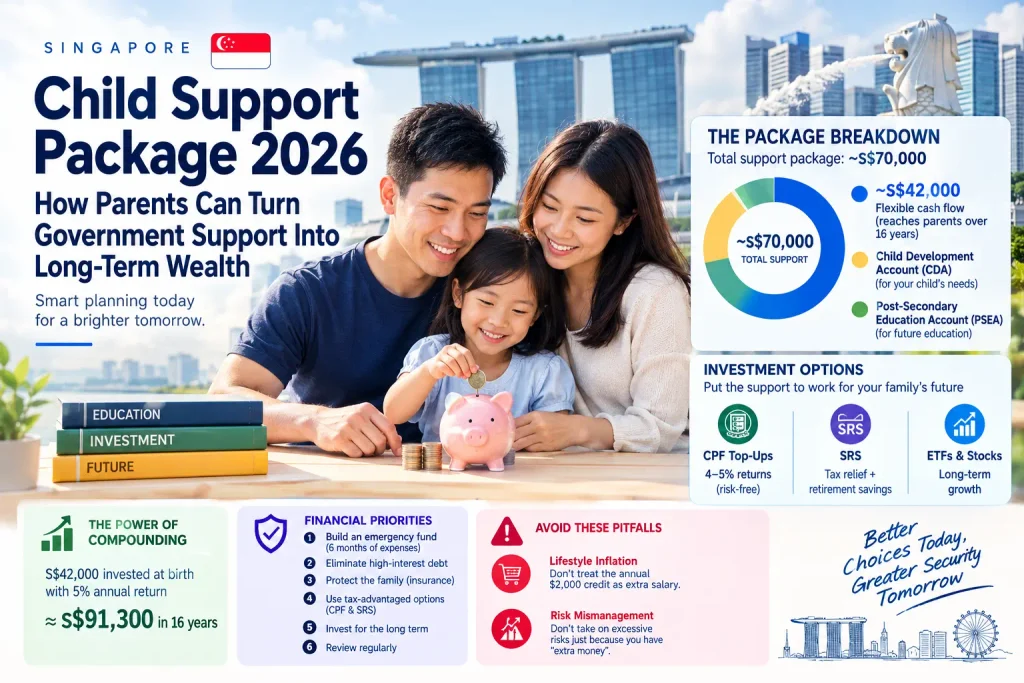
The overall package is valued at approximately S$70,000, according to the discussion.
However, parents should understand that the headline figure does not mean S$70,000 will simply arrive in their bank accounts.
Approximately S$42,000 represents flexible cash flow that reaches parents over a 16-year period, while the remaining support is allocated through specific accounts and programmes, including the Child Development Account (CDA) and Post-Secondary Education Account (PSEA).
This distinction is important because parents need to build their financial plans around the money they can actually control.
Instead of viewing the annual support as extra disposable income, financial planners suggest considering whether some of it can be redirected toward long-term wealth building.
The Investment Opportunity: Put Government Support to Work
One of the strongest ideas discussed in the Money Talks episode is to treat the government support as investment capital.
Rather than allowing the additional money to gradually disappear into everyday expenses, parents could potentially use it to strengthen their existing financial strategy.
Depending on their circumstances and risk tolerance, potential options include:
1. CPF Top-Ups
Parents may consider contributing additional funds to their Central Provident Fund (CPF).
CPF savings can provide attractive, relatively stable long-term returns, with certain CPF balances earning interest rates in the range of 4% to 5%, depending on the account and applicable rules.
For financially conservative families, this can provide a way to build retirement wealth without taking the same market risk associated with equities.
2. Supplementary Retirement Scheme (SRS)
Another option discussed is Singapore’s Supplementary Retirement Scheme (SRS).
SRS contributions can potentially provide tax benefits while helping parents build additional retirement savings.
For parents who are already paying income tax, using eligible contributions for retirement planning may offer a double benefit: improving long-term savings while potentially reducing taxable income.
3. ETFs and Stocks
Parents with a longer investment horizon and a higher tolerance for market volatility could consider diversified exchange-traded funds (ETFs) or individual stocks.
The key advantage for a parent investing for a child is time.
A newborn potentially gives the family more than a decade before major expenses such as university arrive. That long horizon can allow investments to benefit from market growth and compound returns.
However, stocks and ETFs carry investment risk, and returns are not guaranteed.
The Power of Compounding Over 16 Years
Perhaps the most powerful concept discussed in the episode is compound growth.
Imagine that S$42,000 were invested when a child was born and generated an average annual return of 5%.
After 16 years, the investment could grow to approximately S$91,300, assuming the return compounds annually and no additional contributions are made.
The important lesson is not that a 5% return is guaranteed—it isn’t.
The lesson is that starting early can dramatically increase the effect of compounding.
Even relatively modest returns can become meaningful when money remains invested for many years.
But Investing Should Not Come Before an Emergency Fund
While investing government support can be attractive, parents should not rush into the market without first establishing financial stability.
The experts emphasize the importance of maintaining an emergency fund equivalent to around six months of expenses.
This should generally come before taking on additional investment risk.
Why?
Because unexpected expenses—such as medical bills, job loss, home repairs or other emergencies—can force investors to sell investments at an unfavorable time.
Once an adequate emergency reserve has been established, parents may have greater confidence to allocate additional capital toward long-term goals.
Government Support Could Also Change How Parents Save
There is another interesting consequence of receiving government support.
Parents often keep large amounts of cash in precautionary savings because they are worried about future child-related expenses.
If government assistance covers part of those expected costs, families may eventually find that they do not need to hold as much excess cash.
That could allow some money previously reserved for precautionary purposes to be redirected toward retirement planning and long-term investments.
In other words, the support could potentially improve not only the child’s financial future but also the parents’ own retirement position.
The Biggest Danger: Lifestyle Inflation
More money entering a household does not necessarily mean more wealth.
One of the biggest risks highlighted in the discussion is lifestyle inflation.
If parents begin treating an annual S$2,000 credit or similar support as ordinary salary, they may gradually increase their household spending.
What initially appears to be a small upgrade—more dining out, larger purchases, additional subscriptions or lifestyle expenses—can become a permanent increase in monthly spending.
Over many years, that can significantly reduce the amount available for saving and investing.
The better approach may be to mentally separate government support from normal income.
If you don’t depend on it for your lifestyle, you have more flexibility to invest it.
Another Risk: Taking Too Much Investment Risk
There is an opposite mistake that parents can make.
After receiving additional government support, some families may feel financially safer and become more willing to take excessive investment risks.
This can be dangerous.
Having additional government assistance does not eliminate market risk.
Investing aggressively in highly volatile stocks, speculative assets or concentrated positions simply because there is “extra money” can lead to significant losses.
The objective should not be to turn every dollar of government support into the highest possible return.
Instead, parents should consider their:
- Emergency savings
- Existing debt
- Retirement needs
- Investment time horizon
- Risk tolerance
- Child’s future education costs
- Overall household cash flow
A Simple Financial Priority Framework for Parents
Parents could think about the support in the following order:
Step 1: Build an emergency fund
Aim for roughly six months of essential expenses before increasing investment risk.
Step 2: Eliminate expensive debt
High-interest debt can undermine investment returns and should be considered as part of the overall financial plan.
Step 3: Protect the family
Review appropriate insurance and financial protection needs.
Step 4: Maximize appropriate tax-advantaged opportunities
Depending on individual circumstances, CPF and SRS may play a role.
Step 5: Invest for the long term
Diversified ETFs and other investments may be considered based on risk tolerance and financial goals.
Step 6: Review the plan regularly
A child’s financial needs change as they grow. Investment allocations and savings targets should therefore be reviewed periodically.
Why This Matters Beyond the Child Support Package
Singapore’s child-support measures are designed to help families manage the financial cost of raising children.
But the way parents respond to the additional support can determine whether the money produces a short-term improvement in household finances or contributes to long-term wealth.
The difference can be substantial.
A family that immediately spends every dollar receives temporary consumption benefits.
A family that uses part of the support to strengthen its financial foundation and invests the remainder appropriately could potentially create a much larger pool of assets over time.
The Bigger Lesson for Singaporean Families
The conversation between Andrea Heng and Ayush Goyal highlights an important principle of personal finance:
Government support should not automatically become lifestyle spending.
Instead, parents can view the money as an opportunity to improve their financial position.
Whether that means strengthening CPF savings, using SRS for eligible tax benefits, investing through diversified ETFs, or simply building a stronger emergency fund will depend on each family’s circumstances.
The most important factor may be discipline.
Money that is given for a specific purpose can easily become part of everyday spending if families do not establish a plan.
But money that is deliberately assigned to long-term goals can potentially become the foundation for future wealth.
Final Takeaway
Singapore’s 2026 child support package, valued at approximately S$70,000 in total support, provides families with meaningful financial assistance. However, the approximately S$42,000 in flexible cash flow over 16 years should not necessarily be viewed as extra salary.
For financially prepared parents, the support could represent an opportunity to strengthen retirement savings, take advantage of eligible CPF or SRS strategies, or invest for long-term growth.
The power of compounding also demonstrates why starting early matters.
At a hypothetical 5% annual return, S$42,000 invested from birth could grow to roughly S$91,300 over 16 years.
But parents should remember that investment returns are never guaranteed, and the priority should be a balanced financial plan rather than chasing maximum returns.
Ultimately, the smartest use of the package may not be about spending more today.
It may be about using today’s support to give both parents and children greater financial security tomorrow.
About the Money Talks Discussion
The analysis is based on the Money Talks podcast episode featuring Andrea Heng interviewing Ayush Goyal of SingSaver, which discusses strategies for making the most of Singapore’s 2026 child-support measures.
YouTube: https://youtu.be/pAtJ9qVmErg?si=3Fxq09xx1bxX24zR
Disclaimer
This article is intended for general informational and educational purposes only. It is not financial, tax or investment advice. Government benefits, CPF/SRS rules, tax treatment and eligibility requirements may change. Investment returns are not guaranteed, and investors can lose money. Readers should consult official Singapore government sources or a qualified financial professional before making financial decisions.
luky888download
September 26, 2026 at 11:17 pmQuick installation and the app is very light on memory. Everything is optimized for a great experience. Get it now at luky888download.
d188com
September 27, 2026 at 11:13 amReally impressed with the variety of games here. It feels very intuitive and the loading times are super fast. Glad I found d188com today.